


ASIA ELECTRONICS INDUSTRYYOUR WINDOW TO SMART MANUFACTURING
NVIDIA Charts Agentic AI Era With New Vera Rubin
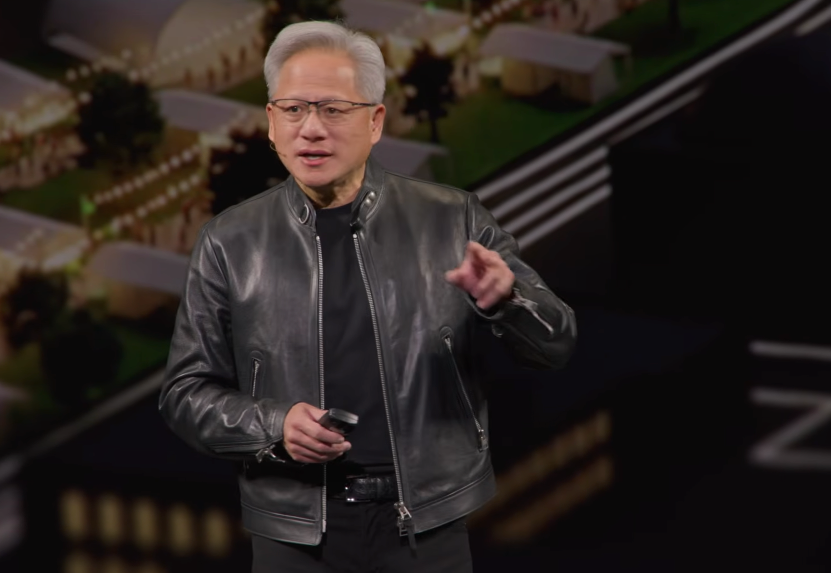
NVIDIA CEO Jensen Huang opened the annual GTC 2026 global developer conference Monday, March 15 in San Jose, California (March 16, Tokyo). Specifically, Huang declared the arrival of the “inference inflection point,” headlined by the launch of the Vera Rubin architecture and a strategic pivot toward Agentic and Physical AI.
Addressing a jampacked crowd at the SAP Center, Huang unveiled the Rubin R100 GPU and a new Vera CPU, positioning the platform as the foundational engine for AI, a market which he said is projected to grow to US$1 trillion by 2027. The announcement marks a shift from models that merely generate content to autonomous “agents” capable of complex reasoning and physical interaction.
“Vera Rubin is a generational leap—seven breakthrough chips, five racks, one giant supercomputer—built to power every phase of AI,” Huang stated. “The agentic AI inflection point has arrived with Vera Rubin kicking off the greatest infrastructure buildout in history.”
Foundation to Most Productive Factories
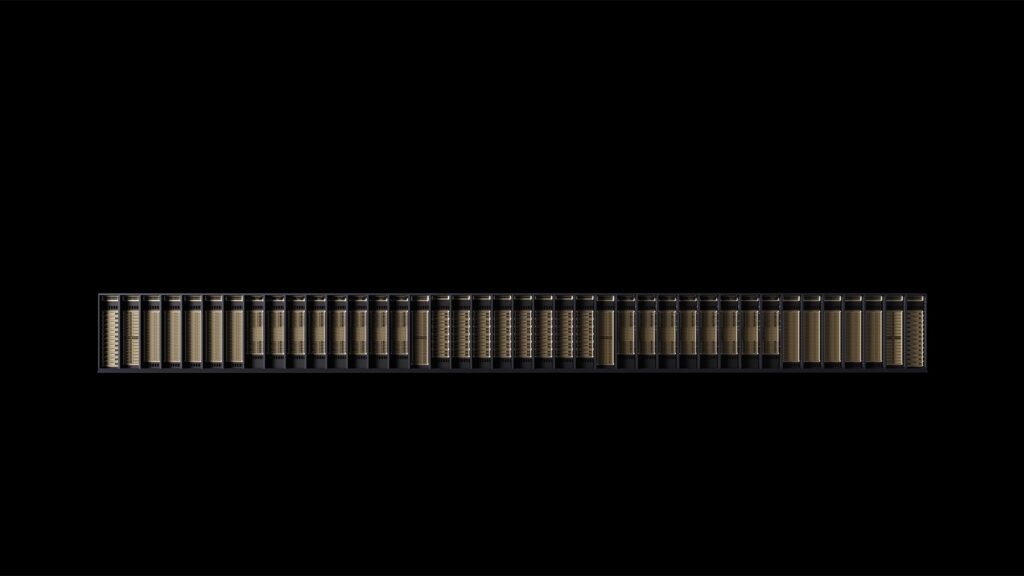
The Rubin platform, succeeding the Blackwell architecture, is engineered for 3nm production. It introduces the Vera Rubin NVL72, a liquid-cooled rack-scale system that integrates 72 Rubin GPUs and 36 Vera CPUs. NVIDIA claims the system delivers up to 10 times higher inference throughput per watt, enabling the training of massive mixture-of-experts (MoE) models with only a quarter of the hardware required by previous generations.
Beyond raw silicon, Huang introduced NemoClaw, an enterprise-grade software stack for the “OpenClaw” autonomous agent framework. This move signals NVIDIA’s intent to dominate the “labor layer” of AI, moving beyond chatbots to systems that execute multi-step workflows across corporate software.
“In the age of AI, intelligence tokens are the new currency, and AI factories are the infrastructure that generates them,” said Huang. “With the Vera Rubin DSX AI Factory design, we are providing the foundation to build the world’s most productive factories.”
The keynote also expanded NVIDIA’s reach into Physical AI. Huang showcased advances in humanoid robotics and autonomous vehicles, supported by the new NVIDIA Cosmos world models. In a surprise conclusion, he revealed Vera Rubin Space-1, a module designed to bring data-center-class AI to orbital data centers, overcoming the extreme cooling challenges of space through advanced radiation-based thermal management.
Major Industry Announcements
Vera Rubin Architecture & R100 GPU
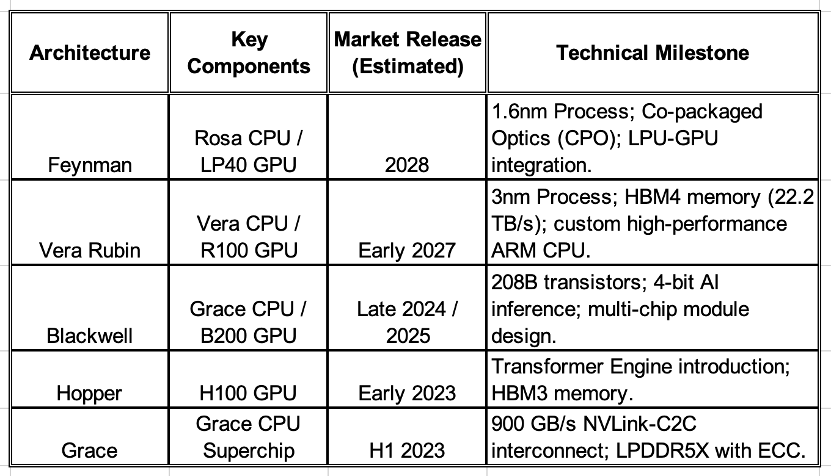
The new 3nm architecture features HBM4 memory providing an unprecedented 22.2 TB/s of bandwidth and introduces the custom Vera CPU, which succeeds the Grace series. This architecture is specifically optimized for Mixture-of-Experts (MoE) models, allowing enterprises to train massive systems with significantly reduced hardware footprints. Announced on March 16, 2026, initial samples are expected to ship to cloud providers by late 2026, with full market availability in early 2027.
Agentic AI & NemoClaw Stack
NVIDIA formalized the shift to “Agentic AI” by launching NemoClaw, an enterprise version of the open-source OpenClaw framework. These “agents” are designed to act as an autonomous workforce that can reason, plan, and execute multi-step workflows across corporate software environments without constant human prompting.
By providing policy-based security guardrails, NVIDIA aims to turn standard enterprise applications into “Agent-as-a-Service” platforms immediately.
Physical AI and Project GR00T N
Huang’s keynote also showcased a massive leap in robotics through Project GR00T N, a new foundation model for humanoid robots that enables “zero-shot” learning of complex physical tasks. Coupled with the NVIDIA Cosmos world model, robots can now simulate and validate behaviors in the Omniverse digital twin environment before being deployed in the real world.
This initiative is intended to transform every industrial company into a robotics company, with deployment cycles for new models expected to begin in late 2026.
Future Roadmap: Feynman Architecture
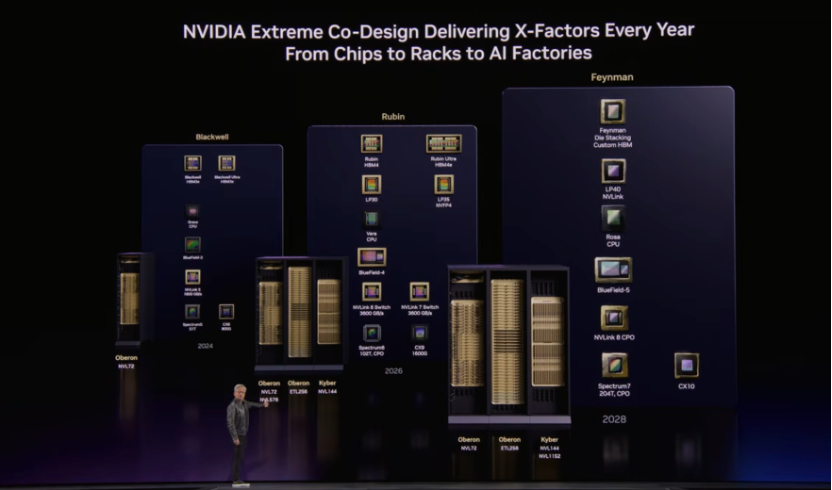
Meanwhile, Huang also teased on what the future would look like as he teased the roadmap details for the Feynman architecture, which is slated for production in 2028.
Feynman will feature the Rosa CPU and introduce co-packaged optics (CPO) to the mainstream, aiming to bridge the gap between electrical signaling and the speed of light. This 1.6nm-class architecture is designed to handle the exponential growth of “Reasoning AI” that Huang predicts will dominate the end of the decade.
At this year’s edition of GTC, Huang doubled his previous revenue projections of the AI market. Specifically, he noted a massive surge in demand for real-time AI inference across global industries, giving a more definitive outlook on the future of the AI era.
“Inference is your workloads and tokens are your new commodity. We have reached that moment…inference inflection has arrived and from this point forward, everything that moves will eventually be autonomous.”
17 March 2026
- Share: