


ASIA ELECTRONICS INDUSTRYYOUR WINDOW TO SMART MANUFACTURING
Arm Launches AGI CPU: A Bold Pivot to AI Silicon
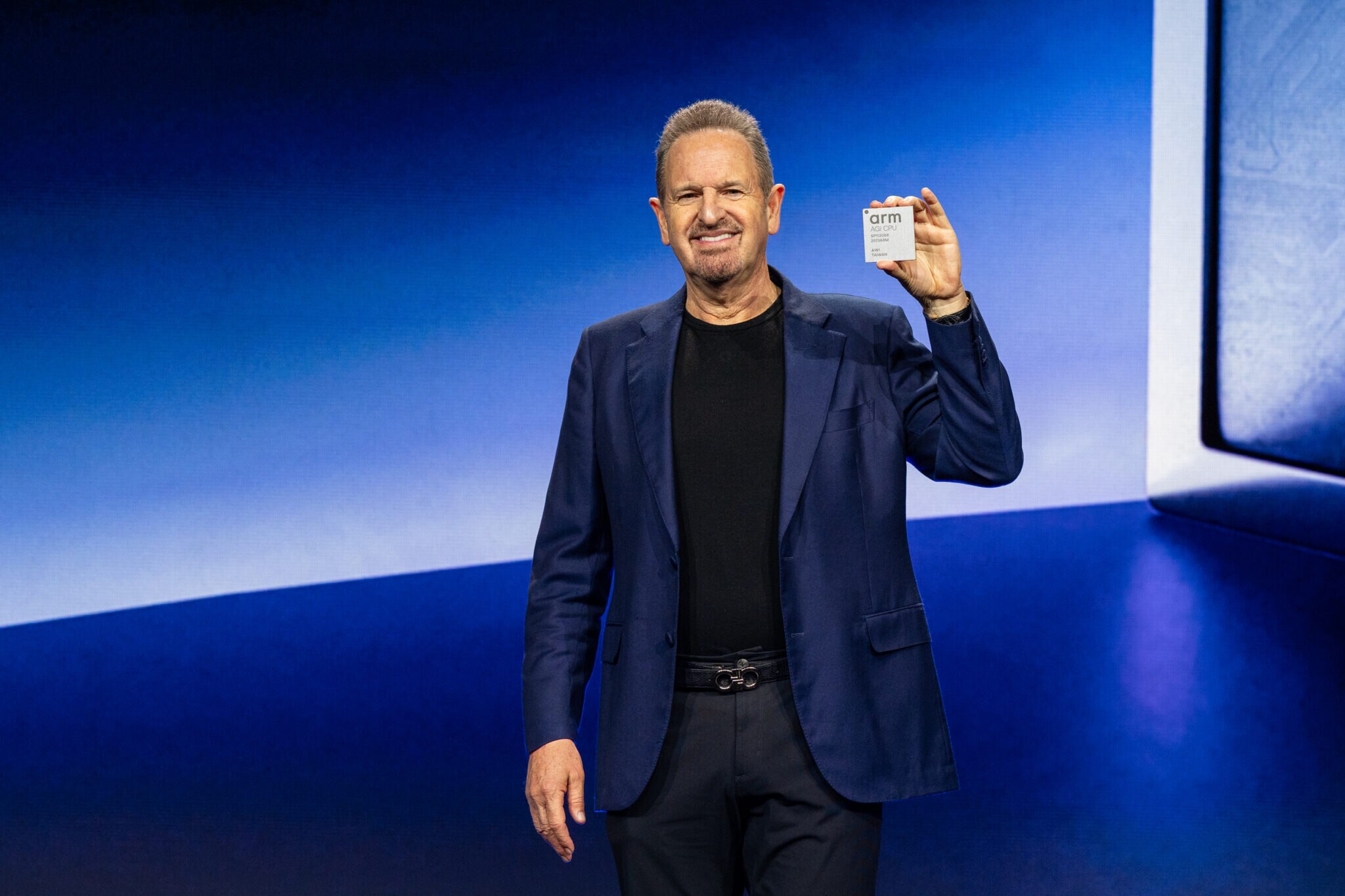
In a move that fundamentally reshapes the semiconductor landscape, Arm CEO Rene Haas announced on March24 (Pacific Time) the company’s first-ever production-ready silicon chip, the Arm AGI CPU, during the “Arm Everywhere” keynote. This historic shift sees the UK-based giant move beyond its traditional role as an Intellectual Property (IP) licensor to becoming a direct supplier of high-performance data center silicon.
The announcement comes as the industry transitions to Agentic AI, which are autonomous systems that perform complex, multi-step workflows. Haas said these agents are “choking” current data centers, creating a massive bottleneck that legacy architectures cannot solve.
“We are now in a new business for Arm, and we are supplying CPUs as chips,” Haas declared at the jampacked keynote at Fort Mason Center for Arts & Culture in San Francisco, California. “Agentic AI only increases the bottleneck… the data center is choking. You need a CPU that has the DNA of being born to run off a battery.”
High-Density Performance
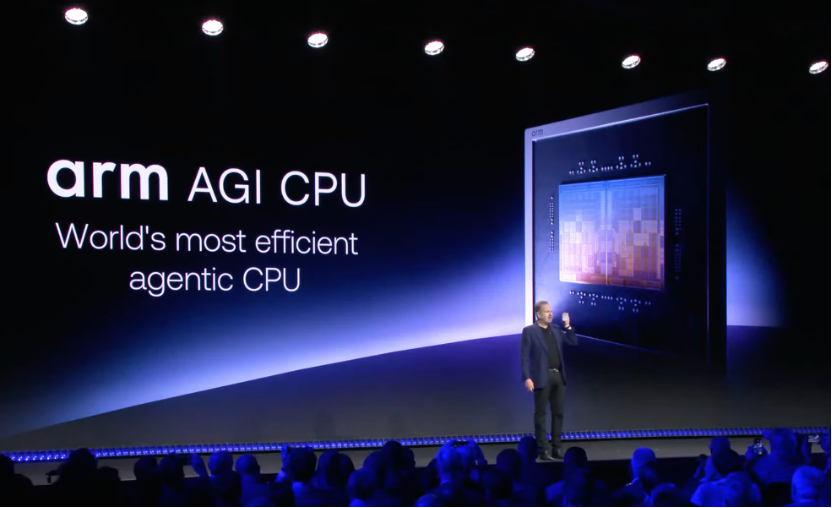
The Arm AGI CPU is built on a 3nm process and features 136 Neoverse V3 cores, delivering what Arm claims is two times the performance per rack compared to x86 equivalents within a 36kW power envelope.
In the same event, Muhammad Al, Arm’s EVP of Cloud AI, highlighted that the chip achieves a remarkable 300W Thermal Design Power (TDP), allowing for unprecedented compute density. Moreover, it supports high-density 1U server chassis that supports air-cooled deployments with up to 8,160 cores per rack, and liquid-cooled systems delivering 45,000+ cores per rack.
“We are not strapped to the past,” Al said, contrasting Arm’s “ruthless focus” with legacy x86 architectures. “We don’t support Lotus Notes… we’re focused on exactly and only what the agentic data center needs: performance, scale, and efficiency,” said Al.
Meta and OpenAI Signal Massive Demand
The keynote featured speakers from Meta and OpenAI, signaling deep industry alignment. Santos Janardan, Meta’s Head of Infrastructure, revealed that Meta acted as a primary co-collaborator on the chip. He detailed Meta’s “Prometheus” clusters, which are projected to reach five gigawatts of capacity—equivalent to the power consumption of 50 cities the size of Palo Alto in California.
“This is not just an Arm CPU; this is a foundational CPU for the whole ecosystem,” Janardan stated. “When we surveyed the market, if we met the performance, we couldn’t get the power. If we got the power, we couldn’t get the performance. That marriage is why Arm ended up being such a partner.”
A US$1 Trillion Vision
The AGI CPU is already in the hands of customers, including Cloudflare, SAP, and SK Telecom, with full production slated for the end of 2026. Haas closed the event by outlining a roadmap for future generations (AGI CPU 2 and 3) and a bold financial outlook.
“We think this represents about a US$100 billion TAM [Total Addressable Market] for us in the future,” Haas said. “By the end of the decade, we think we have an opportunity to address greater than a US$1 trillion TAM across all markets.”
Room for Many Players
During a press briefing which followed the Arm Everywhere event, Haas addressed questions of the pivot made by Arm, which has been operating as a netural architect of the chip ecosystem for 35 years until the Tuesday announcement. Arm’s CEO cited insights of Meta saying the current landscape is not just competitive, but is also “underserved”.
“First off, the only announcement we make today is the Arm AGI CPU,” Haas stated, drawing a firm line around the current product roadmap to avoid speculation on future conflicts. “Regarding the potential competition with our customers… we feel that the market opportunity is very vast and there are room for many, many players.”
With Arm’s new foray, Haas emphasized that selling silicon does not signal the end of licensing model that built the company. Arm, he said, will continue offering IP and comput subsystems to those who would build their own silicon while it will also provide the AGI CPU as a high-performance option, specifically for the data centers, to capture the high-margin Agentic AI market.
25 March 2026
- Share: