


ASIA ELECTRONICS INDUSTRYYOUR WINDOW TO SMART MANUFACTURING
Samsung Stirs Grit in AI Race With First HBM4 Chips
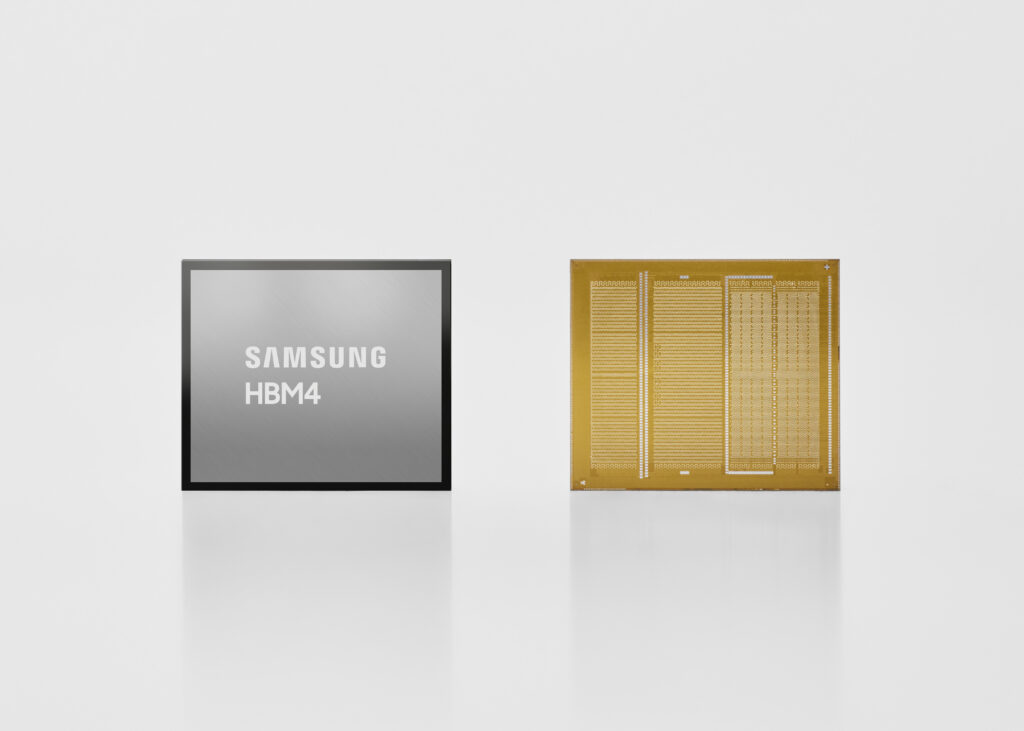
Korean memory chipmaker Samsung Electronics has led the industry in the HBM4 race as it started producing and shipping the most advanced chip so far in the era of artificial intelligence (AI) computing.
Samsung’s announcement marks a first in the industry for the HBM4 market, which will play critical role in satiating global rush for data-hungry AI data centers.
In producing its first HBM4 chip, Samsung leverages its most advanced 6th-gen 10nm class DRAM process for an industry-leading performance.
“Instead of taking the conventional path of utilizing existing proven designs, Samsung took the leap and adopted the most advanced nodes like the DRAM and 4nm logic process for HBM4,” said Sang Joon Hwang, Executive Vice President and Head of Memory Development at Samsung Electronics.
Sets Bar for Performance, Efficiency
Samsung’s HBM4 delivers a consistent processing speed of 11.7Gbps. Therefore, exceeding the industry standard of 8Gbps by approximately 46 percent and setting a new benchmark for HBM4 performance. This represents a 1.22x increase over the maximum pin speed of 9.6Gbps of its predecessor, HBM3E.
Moreover, Samsung’s HBM4 performance can be further enhanced up to 13Gbps, as well, effectively mitigating data bottlenecks that intensify as AI models continue to scale up. In addition, total memory bandwidth per single stack is increased by 2.7x compared to HBM3E, to a maximum of 3.3TB/sec.
Through 12-layer stacking technology, Samsung offers HBM4 in capacities ranging from 24GB to 36GB. The company will also keep its capacity options aligned with future customer timelines by utilizing 16-layer stacking, which will expand offerings to up to 48GB.
In order to address power consumption and thermal challenges driven by the doubling of data I/Os from 1,024 to 2,048 pins, Samsung has integrated advanced low-power design solutions into the core die. HBM4 also achieves a 40 percent improvement in power efficiency with low-voltage TSV technology and power distribution network (PDN) optimizatio.
Samsung said it will continue to advance its HBM roadmap through comprehensive manufacturing resources, where it has one of the largest DRAM production capacities, ensuring a resilient supply chain.
Samsung anticipates that its HBM sales will more than triple in 2026 compared to 2025, and is proactively expanding its HBM4 production capacity. Following the successful introduction of HBM4 to market, sampling for HBM4E is expected to begin in the second half of 2026, while custom HBM samples will start reaching customers in 2027, according to their respective specifications.
13 February 2026
- Share: