



ASIA ELECTRONICS INDUSTRYYOUR WINDOW TO SMART MANUFACTURING
Tanaka’s New Transfer Tech to Boost Chip Performance
TANAKA PRECIOUS METAL TECHNOLOGIES Co., Ltd., has introduced a new a gold bump*1 transfer technology for the sintered gold (Au) bonding technology “AuRoFUSE™ Preforms.” This technology allows AuRoFUSE™ Preforms (gold bumps) to be formed even on semiconductor chips and substrates*2 with complex structures.
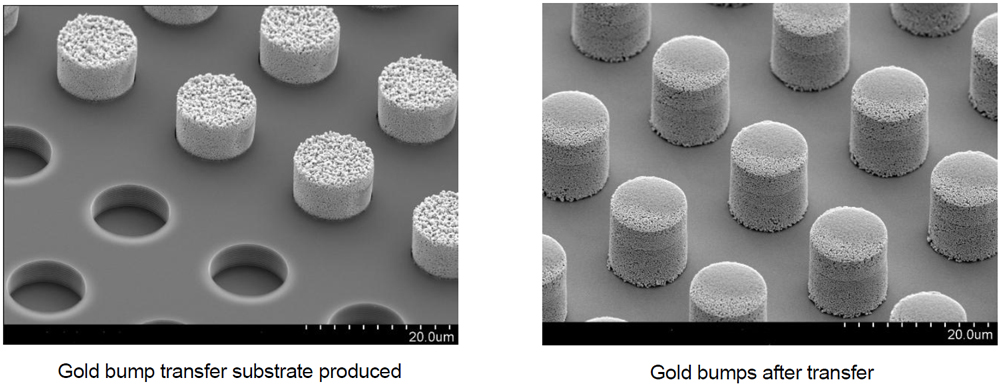
Advantages of being able to transfer gold bumps
In this TANAKA technology, at first, gold bumps are formed on a substrate (transfer substrate). Then, the gold bumps are transferred to the target semiconductor chip or substrate. Openings are created on the silicon substrate used as the transfer substrate, and gold bumps are formed in them. By filling the entire opening, the gold bump is held by the substrate, eliminating the risk of dropping during the process.
Meanwhile, during transfer, the gold bump shrinks under heat-treatment, forming a tiny gap between the opening and the gold bump. This allows easy extraction of gold bumps by the application of a force in the vertical direction.
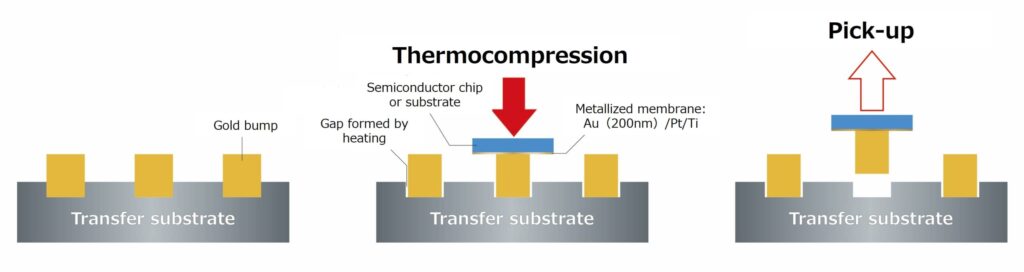
As the traditional gold bump formation process is a method that directly forms bumps on the target semiconductor chip or substrate, it is difficult to handle target chips and substrates with complex shapes, such as protrusions, dents, or open holes due to issues such as inconsistent resist heights.
In this current transfer technology, gold bumps are manufactured separately and can be transferred only to the target locations. This allows the technology to also be applied to complex shapes. It can also be used with semiconductor chips and substrates that are difficult to process using photolithography*3 due to concerns about damage from stripping solutions and others.
Manufacturing of transfer substrate and transfer and bonding process
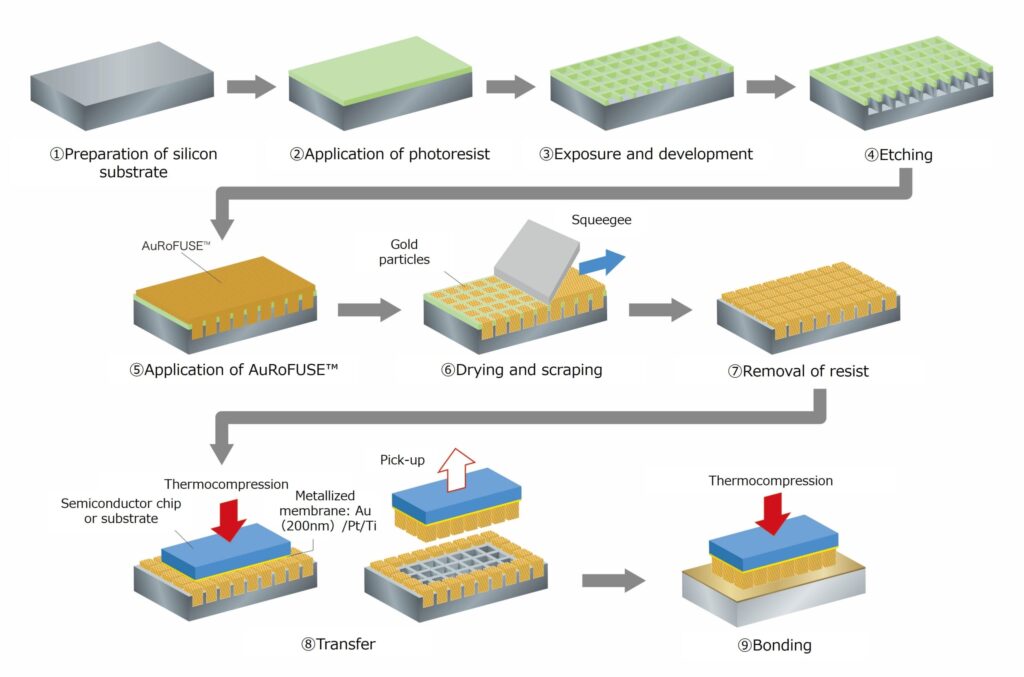
- Preparation of silicon substrate as transfer substrate
- Application of photoresist to silicon substrate
- Exposure and development of target pattern
- Etching of silicon substrate to create holes
- Application of AuRoFUSE™ using a squeegee, etc.
- Vacuum drying of AuRoFUSE™ at room temperature and scraping off excess gold particles on the resist
- Removal of resist to complete transfer substrate
- Placement of transfer substrate on target (semiconductor chip or substrate) for gold bump formation, thermocompression at 10 MPa and 150℃ for one minute, followed by vertical lifting of substrate to transfer gold bumps
- Bonding of post-transfer target through thermocompression at 20 MPa and 200℃ for 10 seconds
An illustration of the traditional gold bump formation process is available in the “Manufacturing of AuRoFUSE™ Preforms” section for reference on TANAKA’s website.
Notes:
*1 Bumps: Protruding electrodes
*2 Substrate: Board that electrically and mechanically supports semiconductor chips mounted on it
*3 Photolithography: Technology for forming fine circuit patterns on substrates
*4 Bonding:Refers to shear strength (strength determined through application of a lateral load during testing)
- Share: