



ASIA ELECTRONICS INDUSTRYYOUR WINDOW TO SMART MANUFACTURING
NXP Unveils Bold ‘Physical AI’ Vision at COMPUTEX
NXP Semiconductors used its COMPUTEX 2026 keynote to set a clear strategic direction for the next phase of artificial intelligence, declaring that the industry is entering the era of “physical AI,” where intelligent systems move beyond the digital realm into real-world applications.
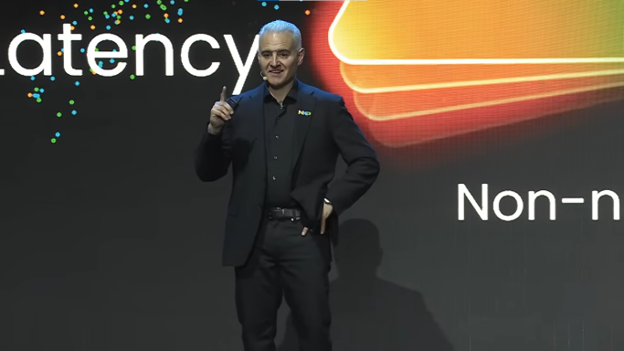
Delivering the keynote, NXP President and CEO Rafael Sotomayor emphasized that the true bottleneck for physical AI is no longer complex reasoning or language processing, but the physical mastery of real-time movement under immense pressure.
“You don’t scale intelligence by making the brain bigger and bigger,” Sotomayor told the audience. “You scale intelligence by putting intelligence at the right place. Intelligence is not about a bigger brain. Stop thinking about a bigger brain. Think about a neural axis.”
Sotomayor discussed deeper on NXP’s “Neural Axis” architecture—a specialized, three-layered structural blueprint designed to bring lightning-fast, biological-style reflexes to drones, software-defined vehicles (SDVs), and advanced humanoid robotics.
Solving Moravec’s Paradox at the Edge
Sotomayor framed NXP’s latest engineering milestones around Moravec’s paradox: the long-standing robotic counterintuitive rule that high-level reasoning is computationally easy for machines, but low-level sensorimotor skills are profoundly difficult.
To bridge this gap, NXP’s Neural Axis framework mimics the evolutionary design of human biology, separating intelligence into three independent but highly coordinated tiers: the reasoning layer (the cerebrum), the coordination layer (the cerebellum), and the reflection layer (the spinal cord).
By pushing the reflex layer directly to the outer edges of hardware—such as joints, ankles, and hands—machines can achieve ultra-low latency, distributed control, and extreme energy efficiency.
Sotomayor underscored the life-and-death stakes of edge processing over cloud dependence, noting that physical accidents cannot be reversed.
“Mistakes and errors at the edge… they’re not digital. You cannot do a software patch for a broken bone. You cannot do a system update to deal with a collision… The real world has no undo button.”
Neural Axis in Action: Drones, SDVs, and Humanoids
NXP demonstrated the immediate commercial deployment of its Neural Axis architecture across three primary form factors:
- Drones: Utilizing NXP’s integrated system ecosystem, industrial drones achieved a “glass-to-glass” processing latency of just 20m/sec. Sotomayor warned that missing this tight loop window causes drift and instability, whereas hitting it makes the drone feel stable and safe.
- Software-Defined Vehicles (SDVs): NXP highlighted its market leadership in central compute architectures with its 5nm S32N family of processors handling vehicle dynamics. Meanwhile, mission-critical functions like braking and suspension are relegated to the hardware’s localized reflexive layer, powered by the S32K product family.
- Humanoid Robotics: For robots navigating unpredictable factory floors, Sotomayor stated that a 40-millisecond window is required to recover balance or adjust a grip. This demands localized intelligence that acts autonomously. “Hands know how to grab. Ankles know how to balance. Not waiting. No asking for permission. Acting,” Sotomayor declared.
The eIQ Toolkit
Addressing the software complexities of physical AI, Sotomayor discussed the rise of Vision-Language-Action (VLA) models, which act as a bridge between what a robot sees, hears, and executes. Because VLAs are traditionally built in resource-unlimited cloud environments, NXP is leveraging its proprietary eIQ toolkit to optimize these models for highly constrained edge environments. The toolkit prunes, quantizes, and compiles massive models, tuning them directly for target edge hardware to drastically reduce deployment friction for enterprise clients.
Sotomayor revealed that physical AI-enabled robots deployed in factory automation are driving a 40 percent productivity enhancement over traditional automated lines. NXP’s deep collaboration with Boston Dynamics is combining edge hardware with robotic platforms to safely harmonize human-robot workflows on the factory floor.
Furthermore, in the healthcare sector, diagnostics and laboratory robotics saw a massive 610 percent sales surge in 2025, supported by key partnerships like NXP’s work with GE Healthcare on high-precision anesthesia delivery systems.
Outlook
NXP’s COMPUTEX 2026 keynote signals a significant shift in how the semiconductor industry is thinking about AI deployment. By moving intelligence into the physical world, the company is targeting markets that demand reliability, efficiency, and security at scale.
While the concept of physical AI is still evolving, NXP’s emphasis on edge computing and real-world applications positions it to play a central role in this next phase of AI development.
As Sotomayor concluded, the transformation is not incremental—it represents a fundamental redefinition of how AI interacts with the world around us.
04 June 2026
- Share: