ASIA ELECTRONICS INDUSTRYYOUR WINDOW TO SMART MANUFACTURING
ST Advances Unified MCU Roadmap for AI Era
STMicroelectronics has unveiled a unified STM32 microcontroller platform designed to support industrial, automotive, robotics, and emerging physical AI applications, marking a strategic shift toward a common architecture and software foundation across multiple end markets.
The initiative expands the scope of the STM32 ecosystem beyond traditional industrial applications by enabling greater software reuse and development continuity across product families while addressing market-specific requirements for safety, security, qualification, and longevity.

The move comes as automotive systems, industrial automation platforms, robotics, and AI-driven infrastructure increasingly demand similar capabilities, including real-time control, connectivity, functional safety, and edge intelligence.
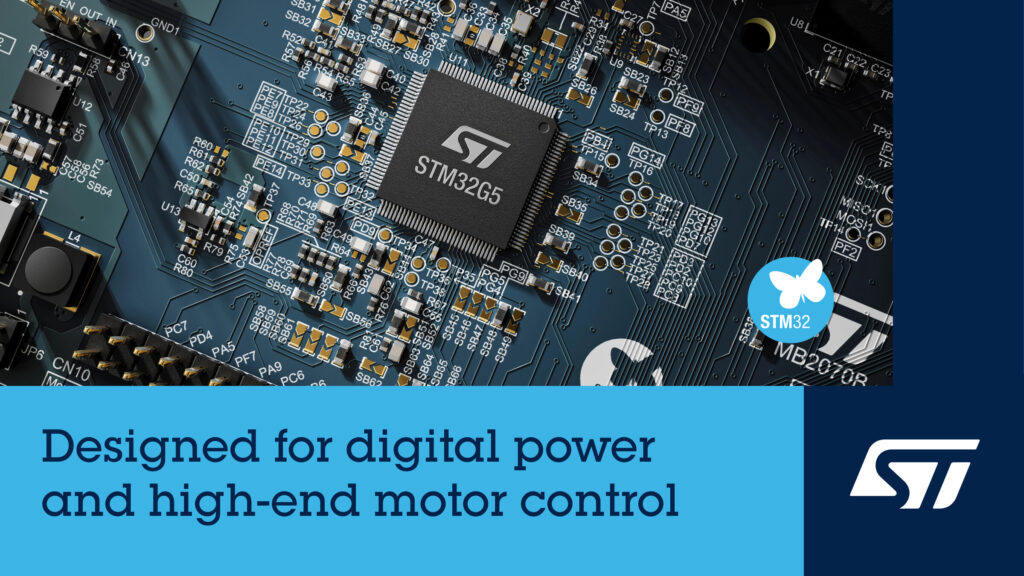
ST outlined the strategy during STM32 Summit 2026, where the company introduced the new STM32A family for automotive and safety-critical applications and unveiled the STM32G5 series aimed at AI datacenters, robotics, motor control, and digital power systems.
Building a Common MCU Foundation
At the core of the initiative is a unified architecture intended to allow developers to move software, tools, and intellectual property more easily across application domains.
“Embedded innovation should not require developers to start again with every new product. With the unified STM32 platform, we are creating a foundation they can trust across markets and generations,” said Remi El-Ouazzane, President of STMicroelectronics’ Microcontrollers, Digital ICs and RF Products Group.
He added: “The industry needs less fragmentation and a stronger focus on helping MCU technologies converge around a common foundation, while maximizing software reuse.”
The platform maintains continuity through common Arm Cortex-M architectures, the STM32Cube software ecosystem, and shared process technologies intended to support future generations of STM32 products.
“The next major frontier for computing is bringing intelligence into the machines that move, manufacture and operate in the physical world,” said Drew Henry, Executive Vice President, Physical AI, Arm. “Building on more than two decades of collaboration, Arm and STMicroelectronics are advancing Cortex-M together to meet the demands of intelligence at the edge.”
Automotive Expansion Meets AI Infrastructure
The new STM32A family extends the STM32 platform into automotive and high-safety applications, covering use cases ranging from vehicle control systems to industrial automation, robotics, energy infrastructure, and multi-domain safety systems.
At the same time, ST introduced the STM32G5 family as a higher-performance platform targeting applications experiencing growing computational and control requirements.
Built around an Arm Cortex-M33 core operating at 280MHz, STM32G5 devices deliver more than twice the compute performance of the previous STM32G4 generation while incorporating advanced motor-control, digital-power, and security features.
According to ST, the devices are designed for environments where efficiency and precision are increasingly important, including AI datacenters, renewable-energy systems, industrial drives, commercial drones, and advanced robotics.
“This new generation of microcontrollers addresses the challenge to meet the growing energy needs of AI datacenters efficiently, realize more sophisticated humanoid robots, and power more complex motor-control systems,” said Patrick Aidoune, General Manager of ST’s General Purpose and Automotive Microcontrollers Division.
Together, the announcements highlight ST’s effort to establish STM32 as a cross-industry embedded computing platform as physical AI applications drive greater technology convergence across industrial and automotive markets.
05 November 2026
- Share: