


ASIA ELECTRONICS INDUSTRYYOUR WINDOW TO SMART MANUFACTURING
DNP’s Latest Tech to Soar Advanced Logic ICs
Japanese Dai Nippon Printing Co., Ltd. has developed a nanoimprint lithography (NIL) template featuring a circuit line width of 10nm. The new template enables patterning for logic semiconductors equivalent to the 1.4nm generation and meets the miniaturization needs of cutting-edge logic semiconductors.
Background of Development
In line with the shift to more sophisticated devices seen in recent years, demands have emerged for even greater miniaturization in cutting-edge semiconductors, leading to advances in extreme ultra-violet (EUV) lithography-based production. EUV lithography, however, requires substantial capital investment, energy consumption, and operating costs in building production lines and the exposure process.
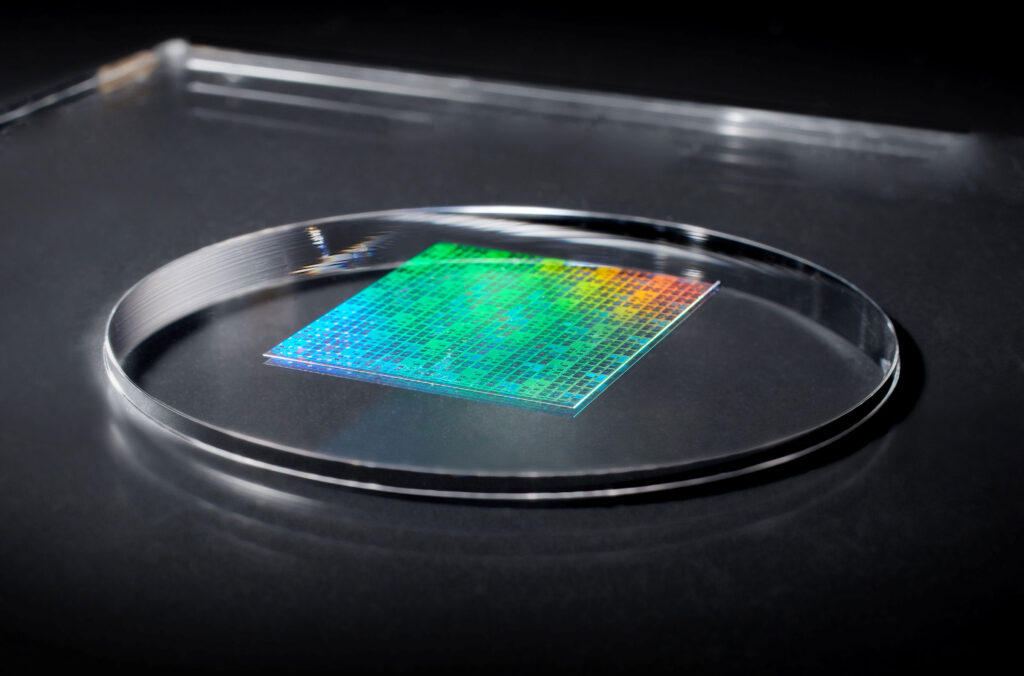
Since 2003, DNP has been developing NIL templates and has successfully accumulated extensive know-how in high-precision patterning.
In this latest development, DNP has developed a NIL template with a 10nm line pattern. It can replace a portion of the EUV lithography process, facilitating the manufacture of cutting-edge logic semiconductors for clients that do not have EUV lithography production processing.
Key Features
DNP has successfully achieved the new NIL template with a circuit line width of 10nm by leveraging Self-Aligned Double Patterning (SADP), which doubles pattern density through film deposition and etching a pattern formed by the lithography device.
The technology also reduces power consumption in the exposure process of cutting-edge semiconductor manufacturing. Driven by an energy-saving processing technology for ultra-fine semiconductors using NIL, it is now possible to reduce power consumption to approximately one-tenth of currently available exposure processes, such as Argon Fluoride (ArF) immersion and EUV.
DNP has started evaluation work for NIL templates, and aim to start mass production in 2027. DNP will advance the further development of NIL templates and enhance production capacity to meet growing demand, targeting increased NIL sales of ¥4 billion in FY 2030.
10 December 2025
- Share: