



ASIA ELECTRONICS INDUSTRYYOUR WINDOW TO SMART MANUFACTURING
Motion Control Redefines Yield in Advanced Packaging
The semiconductor industry is currently navigating its most significant shift in its landscape in decades. In fact, the industry now has moved from single-die scaling to heterogeneous integration, specifically through advanced packaging techniques like wafer-to-wafer hybrid bonding, fan-out packaging, and high-bandwidth memory (HBM) stacking.
However, advanced packaging has created new process bottlenecks. As alignment tolerances compress from the micron domain into the tens of nanometers, the internal mechanics of packaging equipment have shifted from “background automation” to “yield-critical infrastructure.”
The industry is reaching a tipping point where traditional incremental improvements are no longer sufficient.
In this interview, Justin Bressi, Business Development Manager at Aerotech Inc., discusses the engineering challenges emerging across production environments for hybrid bonding, fan-out packaging, and glass interposer manufacturing in advanced packaging and how system-level motion design is reshaping what precision means in semiconductor assembly.

Nanometer Tolerances Expose System-Level Error
In the micron era of packaging, a “good enough” motion system could rely on high-resolution encoders to fix errors after they were detected. In the nanometer era, this is no longer possible.
Asked on what is driving the spike in motion-related failures in next-generation packaging equipment, Bressi said, “The primary driver is the tightening of alignment tolerances from the micron domain into the nanometer domain.” At the nanometer scale, position stability is no longer determined by encoder resolution alone. Instead, Bressi says it depends on how mechanical stiffness, thermal behavior, controller latency, cabling dynamics, and metrology timing interact while executing precise motion profiles.
Processes such as wafer‑to‑wafer hybrid bonding, high‑bandwidth memory stacking, and through‑glass via drilling bring these interactions into sharp focus. Any deviation in planarity, any undamped vibration mode, or any drift over time becomes visible as yield loss. As Bressi puts it, “effects once considered negligible now matter.”
“System‑level precision is not a property driven by any one individual component,” Bressi emphasizes. “It is the emergent behavior of the entire motion system.” As a result, incremental fixes are no longer sufficient.
Why Legacy Architectures Won’t Work
A common pitfall for equipment manufacturers is the attempt to solve these new tolerances through traditional upgrade paths. That is, upgrading individual components such as swapping to a higher-resolution encoder, adding compensation routines, or selecting a stiffer stage.
However, Bressi said these changes often fail to fully address the problem once tolerances fall into the nanometer range. In fact, every source of error shares the same budget and these errors interact and compound.
The reality is that legacy motion architectures, often built on stacked mechanical assemblies and PID-only control loops, break down when “correction latency” exceeds the mechanical response time of the system.
Bressi says, “The shift required is conceptual: motion must be co-engineered with the process, rather than added on as an automation layer. Integration, not component improvement, becomes the mechanism by which stability is achieved.”
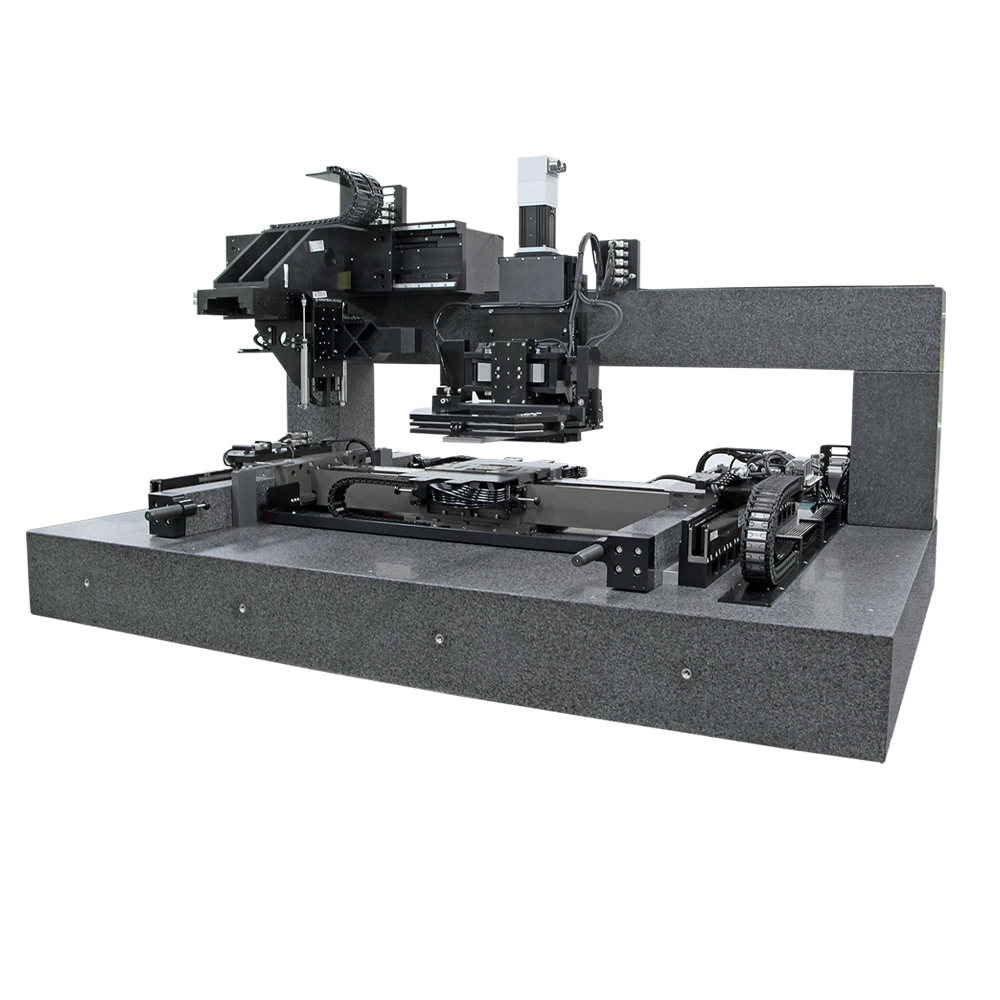
In high-throughput bonding tools, where sub-micron alignment and planarity determine yield, Bressi notes alignment cannot be attributed to any single element.
Achieving this requires the combined effect of mechanical architecture, metrology feedback, control strategy, and thermal stability. Direct‑drive structures reduce compliance, air bearings enable near‑frictionless motion, and high‑resolution digital encoders or laser interferometers deliver nanometer‑scale feedback. Synchronization latencies are tuned into microseconds, while material selection and heat‑path design dictate how systems behave under extended, high‑dynamic operation.
Through‑Glass Via Drilling Pushes the Limits
Among advanced packaging processes, Bressi identifies through‑glass via (TGV) drilling as a “worst‑case” motion problem. The challenge lies in combining extreme accuracy with aggressive throughput while coordinating multiple subsystems in real time.
In production, this requires servo stages and galvo scan heads to operate as a single coordinated motion system. Infinite Field of View (IFOV) blends their motion to eliminate stitching errors, while Position Synchronized Output (PSO) ensures every laser pulse fires at the correct spatial coordinate. Setup and optimization are accelerated through machine‑learning‑based step‑and‑settle tuning, enabling repeatable and scalable TGV performance rather than isolated success.
Reconciling Speed, Precision
In manufacturing, Bressi said precision and speed can conflict if they are treated as independent objectives. “In reality, both are outcomes of mechanical stiffness, inertial sensing, and control design.”
Increasing structural stiffness raises natural resonance frequencies, allowing higher acceleration without inducing vibration. Real‑time inertial feedback, such as integrated accelerometers, supports more aggressive servo tuning without overshoot. Control strategies that reflect the mechanical resonance profile preserve accuracy while maintaining throughput.
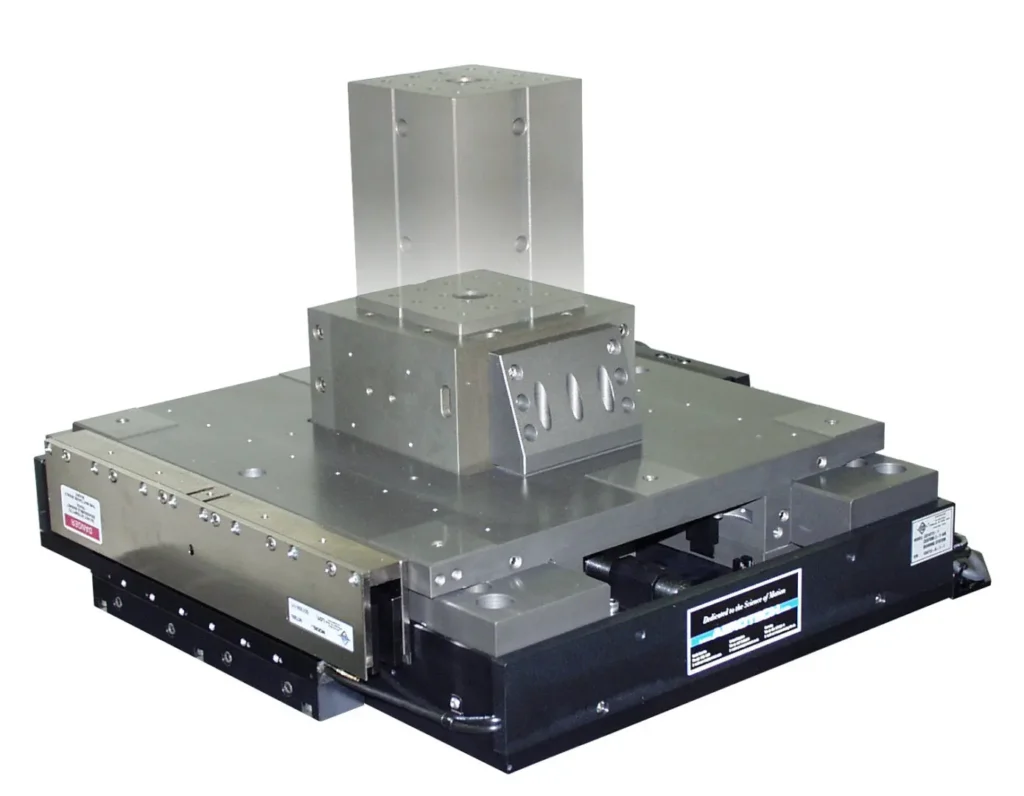
“The goal is not to balance speed against precision,” Bressi concludes, “but to engineer the system so that speed and precision are both reinforced by the system architecture.”
Challenges of Equipment Builders: From Lab to Fab
As advanced packaging tools transition from R&D into high‑volume manufacturing, Bressi highlights control‑platform discontinuity as a common stumbling block. Many systems shift architectures between development and production, forcing costly re‑tuning, re‑validation, and software reintegration.
“Consistent control architecture from prototype through pilot and into production avoids this disruption,” he says. Motion behavior, software, and servo tuning should travel intact across the development cycle. “The motion architecture should scale with the tool, not reset when production begins.”
Looking forward, Bressi sees motion control evolving toward tighter integration of motion, sensing, and real‑time analysis. Instead of correcting drift after it occurs, next‑generation systems will predict and compensate continuously based on mechanical and thermal models. Motion data and in‑process metrology are increasingly fused, allowing earlier detection and automatic correction.
Machine‑learning‑driven auto‑tuning will further reduce manual optimization as production tools accumulate operational datasets. In this environment, motion platforms are no longer treated as mechanical subsystems but as part of the process architecture itself—an evolution that Bressi views as essential for the next phase of advanced packaging.
27 April 2026
- Share: