


ASIA ELECTRONICS INDUSTRYYOUR WINDOW TO SMART MANUFACTURING
Applied Materials and TSMC Bet Big on AI Scaling
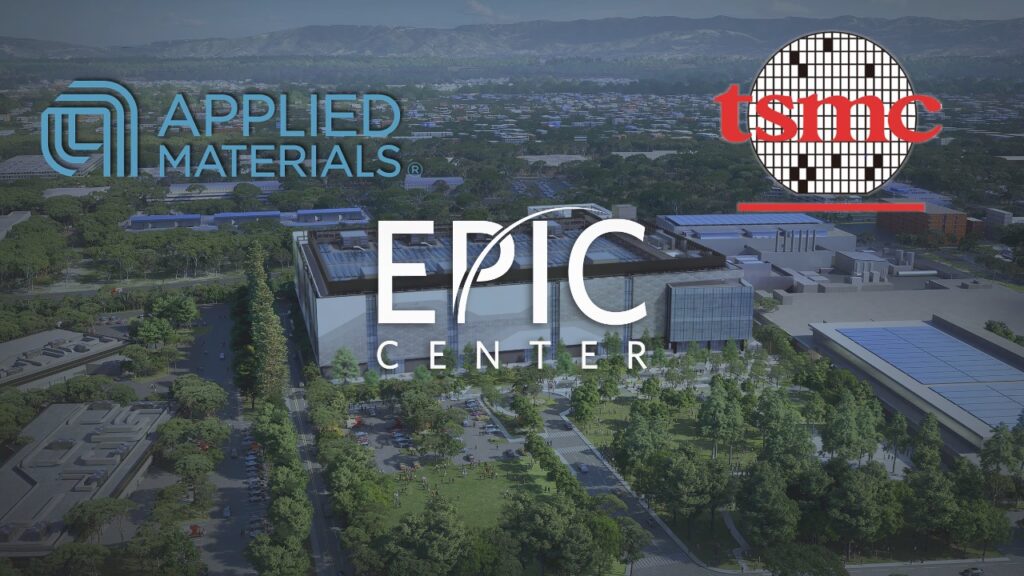
As artificial intelligence (AI) reshapes the semiconductor roadmap, the industry is addressing how to scale increasingly complex chips fast enough to meet surging demand. For that reason, Applied Materials and Taiwan Semiconductor Manufacturing Co. (TSMC) have forged a partnership centered on the EPIC Center, a move that underscores how critical collaboration has become in the AI era.
Building on more than three decades of joint work, Applied Materials and TSMC are expanding their innovation partnership at Applied’s Equipment and Process Innovation and Commercialization (EPIC) Center in Silicon Valley. The shared effort is focused on developing and commercializing the materials, equipment, and process technologies required to scale next‑generation AI semiconductors from the data center to the edge.
Addresses AI Complexity
AI workloads are driving unprecedented complexity in semiconductor manufacturing. As device architectures evolve with each new generation, traditional scaling approaches are no longer sufficient. Materials engineering and process integration now play a central role in sustaining gains in power efficiency, performance, and area at advanced logic nodes. The Applied–TSMC collaboration is designed to address those challenges earlier in the development cycle.
At the EPIC Center, engineers from both companies will work side by side to co‑innovate on solutions aimed at leading‑edge logic scaling. The areas of focus include advanced process technologies that support continuous improvements in power, performance, and density, as well as new materials and next‑generation equipment needed to form increasingly complex three‑dimensional transistor and interconnect structures.
The partnership reflects a shift in how semiconductor innovation is organized. Rather than progressing sequentially from research to manufacturing, the EPIC model brings equipment development and foundry expertise together in a manufacturing‑relevant environment. This approach is intended to speed the transition of breakthrough technologies into high‑volume production, a requirement as AI accelerates product cycles across the industry.
Growing Ecosystem of Parnters
The Applied–TSMC collaboration also anchors a broader innovation ecosystem forming around the EPIC Center. Applied Materials has announced that Arizona State University, Rensselaer Polytechnic Institute, and Stanford University will join EPIC as inaugural academic research partners. While the universities play an important role, their participation is designed to strengthen the Applied–TSMC pipeline rather than redefine it.
University researchers will engage in high‑velocity programs across advanced materials, novel processes, and device technologies, working alongside Applied engineers in an industry‑scale setting. This access allows academic ideas to be tested against real manufacturing constraints much earlier, helping identify which innovations can integrate into production‑ready flows for AI semiconductors.
For Applied and TSMC, the academic partnerships reinforce the lab‑to‑fab pipeline that supports their shared scaling objectives.
As AI continues to push semiconductor technology toward new limits, the Applied Materials–TSMC partnership at EPIC illustrates a growing consensus: scaling AI will require not just better tools or smarter designs, but a fundamentally more integrated model of innovation.
Other companies that have earlier joined Applied Material’s EPIC center include Samsung, Micron, and SKY Hynix.
13 May 2026
- Share: