


ASIA ELECTRONICS INDUSTRYYOUR WINDOW TO SMART MANUFACTURING
Delta Electronics to Accelerate Data Center Buildouts
As artificial intelligence (AI) adoption accelerates, data centers are rapidly evolving into high-performance “AI factories” capable of handling massive computational workloads.
At COMPUTEX TAIPEI 2026 in Taiwan, Delta Electronics spotlighted its latest AI infrastructure innovations under the theme “Superior Efficiency, Shaping Sustainable AI.” The company’s showcase combined 800VDC power architecture, liquid cooling, modular data center systems, and microgrid solutions.
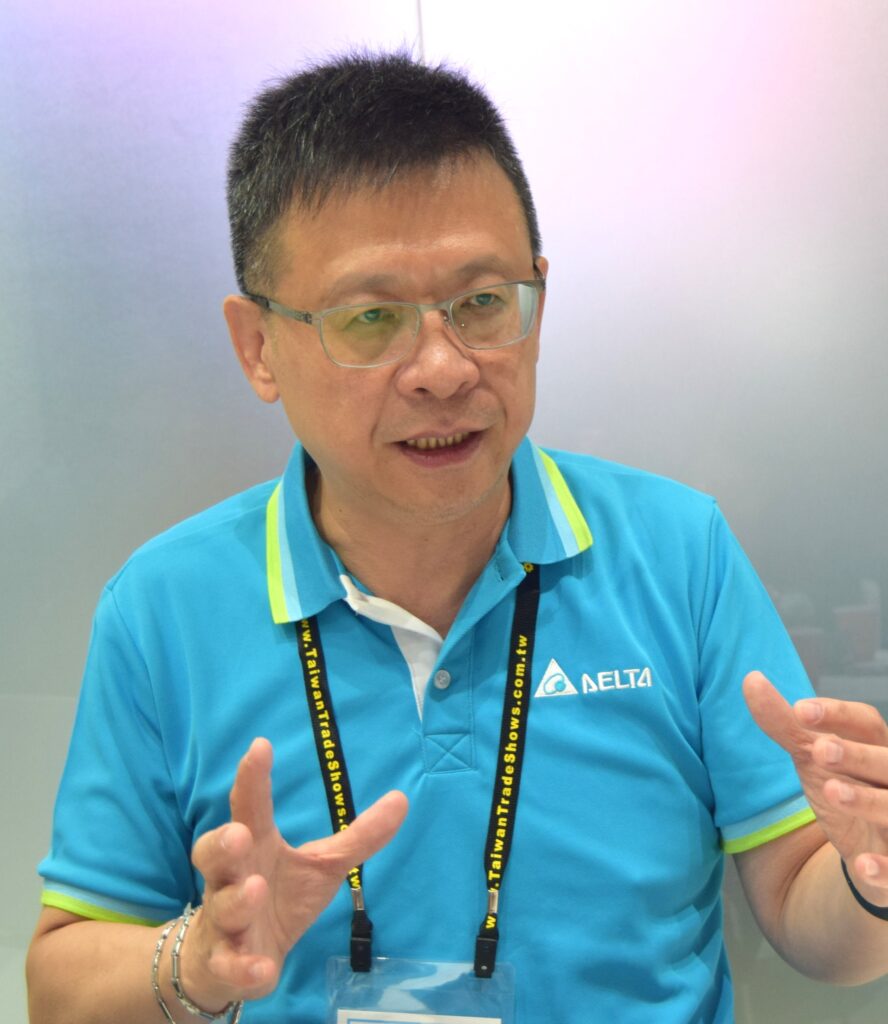
In this interview, Kelvin Huang, Vice President and General Manager of Delta’s Information Communication Technology Infrastructure Business Group, shares insights on the transformation of AI data centers and Delta’s strategy for global markets, including Japan
Anticipating the AI Factory Era
AEI: With the rise of generative AI, data centers are becoming “AI factories.” How do you view this transformation?
Huang: At Delta, we take a forward-looking approach—analyzing how technologies evolve and anticipating future applications. From there, we design infrastructure at the architectural level and develop the enabling technologies needed to support it.
For example, we began developing liquid cooling solutions as early as 2021—well before the AI boom. As GPU thermal design power (TDP) continued to rise, we recognized that traditional air cooling would eventually reach its limits. Rather than reacting to trends, we focused on building the infrastructure required ahead of time.
Maximizing Efficiency with 800VDC and Liquid Cooling
AEI: You are emphasizing a “Grid-to-Chip” approach at this exhibition. What advantages does the 800VDC architecture offer?
Huang: There are two key advantages: efficiency and scalability. In efficiency, it means minimizing power loss across every stage—from the grid to the facility, rack, and ultimately the chip—is critical. Delta’s latest high-voltage direct current (HVDC) solutions achieve energy conversion efficiency of up to 98.5 percent, limiting losses to just 1.5 percent.
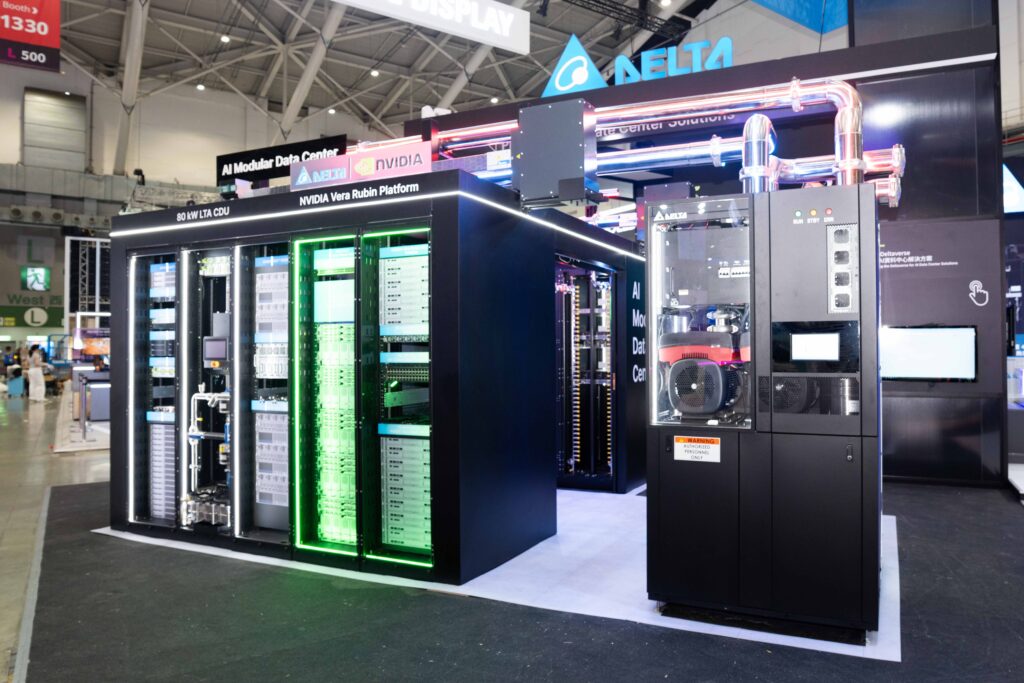
Second, scalability. AI data centers cannot always be built at full capacity from day one; they must scale with demand. Our modular approach allows systems to expand incrementally, much like stacking building blocks. With 800VDC power shelves, we can deliver up to 1.1MW per rack.
AEI: When do you expect liquid cooling to see widespread adoption?
Huang: Liquid cooling becomes essential when power consumption exceeds 1,000W per chip. While earlier GPU generations relied primarily on air cooling, newer platforms are increasingly dependent on liquid cooling to manage rising thermal density.
We expect adoption to be driven by hyperscale cloud service providers and colocation operators. Delta offers a comprehensive portfolio—including coolant distribution unit (CDU), cold plates, and hybrid cooling systems—enabling both new deployments and retrofitting of existing facilities.
Climate Adaptation is Key for the Japanese Market
AEI: What challenges arise when introducing liquid cooling in Japan?
Huang: Climate adaptation is a major factor. In regions with heavy snowfall, freeze prevention measures are essential. Temperature fluctuations can also affect coolant flow and pressure, meaning designs used in North America cannot simply be replicated in Japan.
Liquid cooling must be considered as part of a fully integrated system—encompassing power, cooling, controls, and facility design. Delta’s strength lies in its ability to deliver end-to-end solutions tailored to local environmental conditions.
AEI: What institutional or operational challenges are affecting AI infrastructure expansion in Japan?
Huang: Labor shortages and rising costs are key challenges. To address this, we are promoting prefabricated modular AI data centers. By integrating power, cooling, and racks in the factory, onsite work is significantly reduced—cutting construction time by up to 60 percent.
Ensuring stable power supply is also critical. AI data centers consume enormous amounts of energy, so minimizing grid impact is essential. By integrating microgrids with solar generation and battery storage, operators can enhance resilience while reducing reliance on local utilities.
AEI: Do you agree gaining community acceptance has become a concern for data center projects.
Huang: Data centers are essential infrastructure, but their large energy consumption can raise concerns. To earn community support, operators must prioritize efficiency, integrate renewable energy sources, and minimize grid impact.
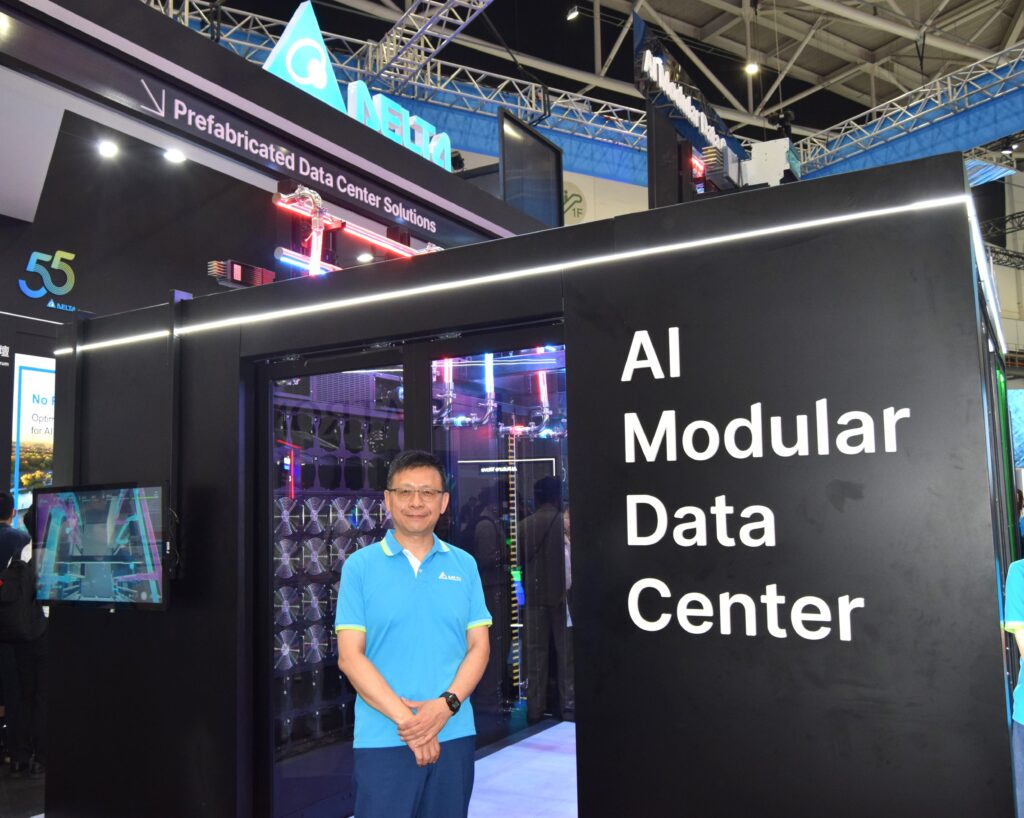
At Delta, we go beyond providing equipment—we deliver comprehensive solutions that address power, cooling, and community integration. Our goal is to help transform data centers into sustainable, community-aligned infrastructure.
Driving Sustainable AI Infrastructure Forward
AEI: What key message conveyed at COMPUTEX 2026?
Huang: Our core mission remains unchanged: to provide innovative, clean, and energy-efficient solutions for a better tomorrow.
AI growth demands significant power, but without improving efficiency, it cannot be sustained. Delta’s strength lies in its ability to integrate technologies across the entire infrastructure—from the grid to the chip. Few companies can offer such a unified approach across power, cooling, facilities, and microgrids.
Looking ahead, we will continue to anticipate future requirements and develop the infrastructure needed to support the next generation of AI-driven industries.
AI data centers are becoming foundational to modern economies, but they bring complex challenges—from energy consumption and heat management to labor shortages and community engagement.
Delta Electronics is positioning itself at the center of this transformation by combining high-efficiency 800VDC power systems, advanced liquid cooling, modular data center designs, and microgrid integration to deliver scalable, sustainable AI infrastructure.
11 June 2026
- Share: