


ASIA ELECTRONICS INDUSTRYYOUR WINDOW TO SMART MANUFACTURING
Delta Scales Up Smart Tech for India's Chip Push
As India expands its presence in global high-tech manufacturing, Delta Electronics is deploying its operational technology and information technology (OT/IT) solutions at the core of this industrial shift.
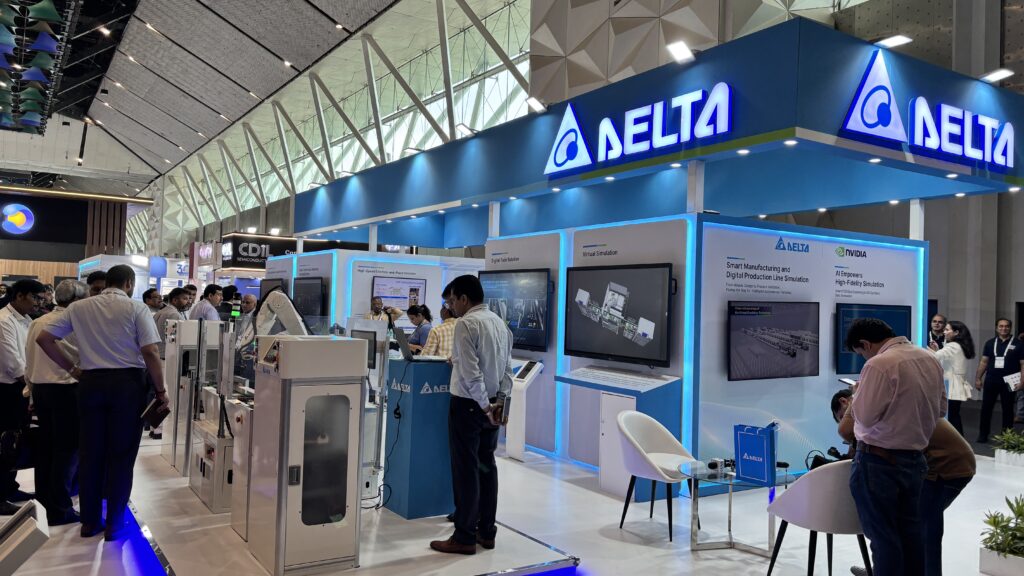
In an interview at SEMICON India, Anil Chaudhry, Head of Department for the Industrial Automation Business Group at Delta Electronics India Pvt. Ltd., detailed how the Taiwanese automation supplier is combining AI digital twin platforms, sub-2-micron motion control, and automated optical inspection (AOI) to support the nation’s semiconductor and electronics ecosystem.
Bridging Virtual Design and Physical Production
To address the high capital expenditure required for greenfield fab and assembly facilities, Delta is focusing on machine-level digital twin technology. By integrating its virtual machine development software with the NVIDIA Omniverse platform, Delta enables plant engineers to simulate, test, and optimize production lines virtually before deploying physical hardware on the factory floor.

“To cut your overall cost of the investment in the beginning, you can have a virtual environment production,” Chaudhry explained. “And you can tweak it, how much I want to do today and how much I want to do after six months… While you are making this virtual environment lines, you can try to change the design in the virtual environment to understand how much flexibility my lines are having.”
This virtual environment allows manufacturers to model complex layouts—such as PCB glue dispensing—and convert verified simulations into executable machine recipes. The approach helps reduce floor space requirements, minimize logistics expenses, and limit scrap costs associated with physical trials.
Sub-Micron Precision and High-Speed Packaging
Semiconductor packaging and Assembly and Testing (OSAT) operations require high placement accuracy and rapid cycle times. Delta addresses these requirements through specialized motion control components, including linear motors and actuators that maintain positioning accuracy under 2 microns with acceleration capacity between 5G and 10G.
“In chip making, the precision and the speed is the most important parameter,” Chaudhry noted. “Delta is having linear modules or linear actuator… which can give you less than 2 micron accuracy and very high speed up to 5G or 10G of acceleration.”
Complementing Delta’s internal component portfolio, its U.S.-based subsidiary, Universal Instruments, supplies specialized machinery for advanced chip packaging and high-speed die pick-and-place applications.
AI Optical Inspection and Clean-Room Management
Beyond motion hardware, Delta integrates AI across its quality control and facility management systems. The company’s AI-driven Automated Optical Inspection (AOI) platforms use synthetic image generation to train inspection models faster, improving defect detection across sensitive electronic components.
For clean-room environments, Delta deploys an AI-based Facility Management Control System (FMCS) alongside automated surveillance tools. These systems monitor utility parameters, personnel movement, and environmental conditions required to maintain yield consistency in semiconductor fabrication units.
Quality Control for Export-Oriented Manufacturing
As Indian manufacturers increase production for export markets, maintaining international quality standards remains a primary requirement. Delta is supporting this transition by expanding its collaborative robot (cobot) line—including its D-Bot series—alongside intelligent grippers and integrated machine vision technology designed for safe human-machine collaboration.
“We are preparing ourselves for the global environment and to export also from India to be a global player,” Chaudhry emphasized. “I see the quality aspects as of now is very, very important for India and all the manufacturers are very serious about that.”
By connecting low-level sensors, edge compute nodes, and cloud monitoring software across its DIA smart manufacturing platform, Delta is positioning its automation stack to support India’s high-tech manufacturing goals.
Cristian Canoza
25 September 2026
- Share: