



ASIA ELECTRONICS INDUSTRYYOUR WINDOW TO SMART MANUFACTURING
Renesas to Boost Robotics With New Beijing AI Lab
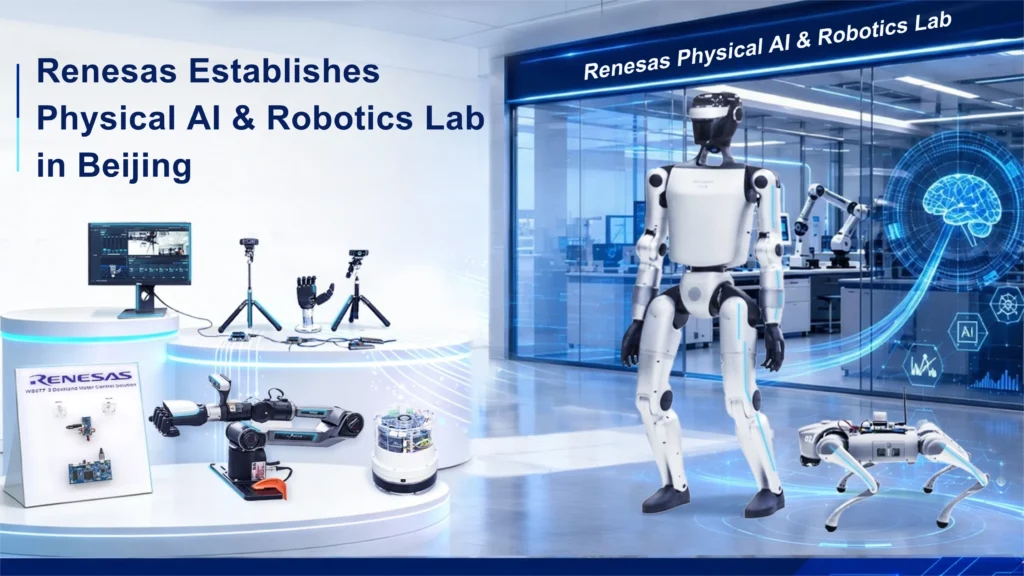
Renesas Electronics Corporation has officially opened its Physical AI & Robotics Lab in Beijing, marking a significant step in its strategy to accelerate the development and deployment of next-generation robotic systems. The new facility is designed to help customers demonstrate, validate and jointly develop robotic technologies while supporting the company’s broader Physical AI initiative from proof-of-concept through large-scale deployment.
The launch comes as Physical AI emerges as a major advancement in artificial intelligence. Unlike digital AI systems that operate exclusively in virtual environments, Physical AI enables machines to perceive, make decisions and take actions safely in real-world settings. As a result, robotics, particularly humanoid robotics, has become a key application area requiring highly integrated technologies across processing, sensing, power management, software and control systems.
Strategic Focus on a High-Growth Market
The establishment of the Beijing lab strengthens Renesas’ commitment to Physical AI as a long-term growth opportunity. It follows the formation of the company’s dedicated Physical AI Division on July 1, 2026.
According to Ivo Marocco, Vice President and Head of UX at Renesas, growing sophistication in humanoid robots is increasing the need for tightly integrated hardware and software ecosystems.
“Humanoid robots are becoming more sophisticated and complex, driving demand for hardware and software systems that must work together seamlessly,” said Marocco. “Today, Renesas can address roughly 30% of the humanoid robot BOM, and we see an opportunity to expand that coverage to 70% through our strengths in control, power, sensing, AI, software and ecosystem solutions.”
He added that the new lab will enable customers to validate complete systems and speed the deployment of next-generation robotics innovations.
Beijing Lab to Connect Customers, Partners and Innovators
The new facility combines hardware, software, AI modeling, sensing, power supply, control technologies and system-level verification capabilities within a single environment. Consequently, customers can access support across the entire engineering process, from design and validation to deployment.
Furthermore, the lab is intended to serve as a collaborative platform linking customer requirements with ecosystem resources and advanced technologies. Beyond product demonstrations, it will support the validation and co-development of complete robotics solutions.
“China continues to lead in robotics innovation and adoption with a deep customer base, a highly collaborative ecosystem and a comprehensive supply chain service system,” said Yvonne Liu, Vice President and President of Renesas China.
She noted that Renesas plans to collaborate closely with customers, ecosystem partners, universities and startups to accelerate the engineering implementation of Physical AI systems.
Comprehensive Portfolio Supports Robotics Growth
Renesas enters the Physical AI and humanoid robotics market with capabilities spanning brain and motion control, sensing, actuation and power management. Leveraging decades of experience in automotive and industrial applications, the company combines hardware technologies with functional safety, edge AI and its cloud-based Renesas 365 development platform to help customers build safer, smarter and more scalable robotic systems.
28 August 2026
- Share: