

ASIA ELECTRONICS INDUSTRYYOUR WINDOW TO SMART MANUFACTURING
SEMICON India 2026: Chip Investors Rally Behind India’s Next Growth
India’s semiconductor ambitions gained fresh momentum at SEMICON India 2026 as policymakers, global technology leaders, manufacturers, investors and researchers gathered in New Delhi to advance the country’s rapidly expanding chip ecosystem.
The second day of the event showcased India’s widening influence across semiconductor manufacturing, design, advanced packaging, supply chains, materials, research and talent development. More importantly, it highlighted how the country is transitioning from policy ambition to large-scale execution, supported by growing international participation and rising investor interest.
The event featured more than 600 companies, including around 300 international exhibitors, while participation from major semiconductor economies reinforced India’s growing role in the global industry. Organizers expect the event to attract around 50,000 visitors from 52 countries alongside more than 400 executives and over 150 speakers.
India Unveils Next Phase of Semiconductor Expansion
During a press conference, Ashwini Vaishnaw, India’s Union Minister for Electronics and Information Technology, outlined the next phase of the country’s semiconductor strategy.
“India’s semiconductor mission has moved from proving intent to execution at scale,” he said.
According to the minister, ISM 2.0 will build on the foundation established under the first phase of the India Semiconductor Mission through six focus areas: design, machines and materials, new fabrication facilities, strengthening the ATMP/OSAT industry, research and development, and talent development. He noted that ISM 1.0 achieved its objectives in four years despite being originally planned as a six-year program, and expressed confidence that the next phase would advance at a similarly accelerated pace.
Design remains a major pillar of India’s semiconductor ambitions. The minister projected the emergence of at least 200 chip design companies under ISM 2.0 and described the sector as a “game changer” for creating indigenous semiconductor intellectual property. More than 105 design startups have already gained access to advanced Electronic Design Automation tools, while 20 startups have secured venture funding. Around 70,000 chip-design engineers have also been trained over the past four years.
Strategic Deals Strengthen the Semiconductor Value Chain
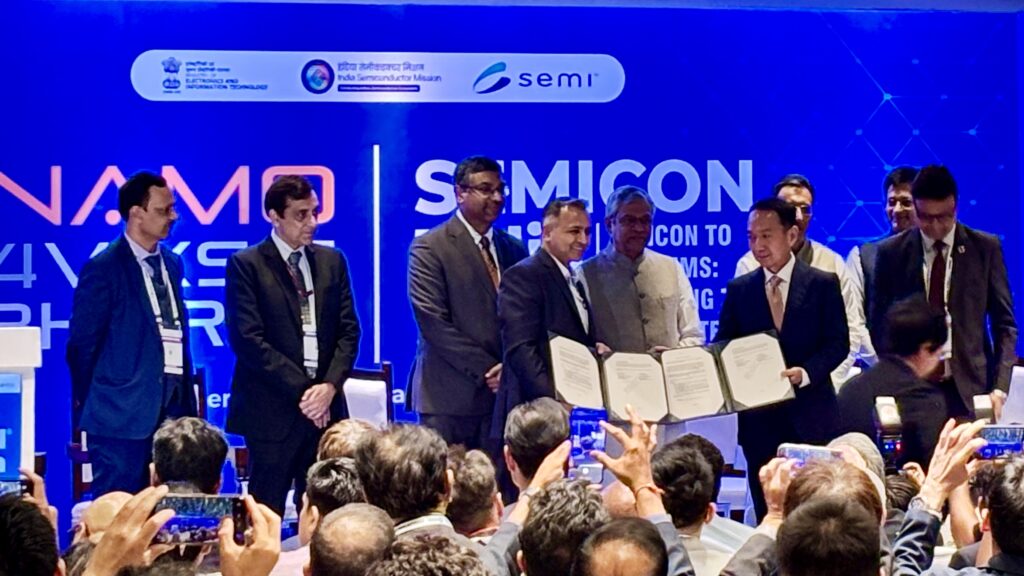
Day two generated significant business activity, including 25 memorandums of understanding, announcements and strategic collaborations involving domestic and global partners. This is on top of the 16 announced MoUs entered and signed between domestic and global partners on Sept. 17, the first day of the three-day event.
These initiatives covered semiconductor materials, manufacturing, power electronics, advanced packaging, logistics, design technologies, workforce development and deep-tech investment.
One notable agreement involved the India Semiconductor Mission and Nippon Express. Under the partnership, the company will contribute expertise in logistics, warehousing and customs processes to support India’s expanding semiconductor ecosystem.
The collaborations also focused on critical material localization, indigenous silicon carbide technologies, design tools and specialized supply-chain capabilities, helping strengthen domestic resilience while supporting future industry expansion.
Global Partnerships Gain Strategic Importance
International cooperation emerged as another major focus area. Vikram Misri, India’s Foreign Secretary, stressed the importance of trusted partnerships in building resilient semiconductor supply chains.
He said resilient semiconductor value chains require trusted global partnerships built on reliability, credibility, incentives and value creation. He also called for a balanced approach that combines domestic strengths with global capabilities.
Dedicated country roundtables involving Singapore, Europe and South Korea explored opportunities in manufacturing, advanced packaging, R&D, materials, investment, testing and talent development. Participants examined ways to combine India’s engineering expertise and market scale with international strengths in manufacturing technologies, advanced materials and capital investment.
The event also attracted strong participation from Japan, Singapore, South Korea and multiple European countries, reflecting increasing global interest in expanding semiconductor-related activities in India.
20 September 2026
- Share: