
ASIA ELECTRONICS INDUSTRYYOUR WINDOW TO SMART MANUFACTURING
Dual-Function Ultrasonic Sensor Expands Robot Sensing
Fraunhofer IPMS and Cosys-Lab at the University of Antwerp have developed a compact ultrasonic sensing system designed to give robots both environmental perception and infrastructure monitoring capabilities through a single sensor platform. The system, called PiCASo, combines sonar-based mapping with ultrasonic leak detection in a package small enough for integration into compact robotic platforms.
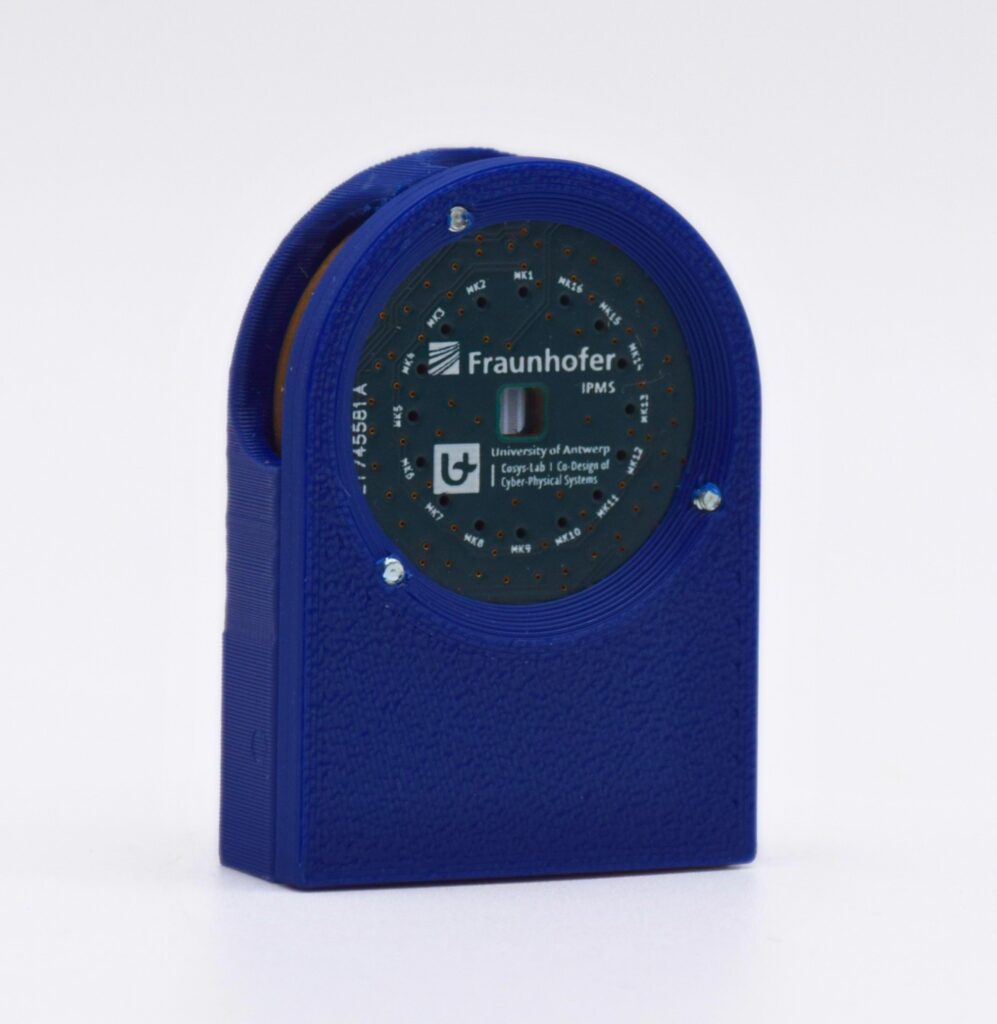
The development comes as autonomous systems increasingly require sensing technologies that can operate when optical approaches encounter limitations. According to the researchers, cameras and LiDAR can be affected by dust, smoke, fog, poor lighting, and other visibility challenges. PiCASo uses ultrasound to complement those systems by emitting sound waves and analyzing returning echoes to build an acoustic representation of its surroundings.
Combining Perception and Monitoring
At the core of PiCASo is a micromachined ultrasonic transducer (L-CMUT) developed by Fraunhofer IPMS. The device measures 4 × 4 mm and operates across a frequency range of roughly 20 to 80 kHz. The transducer is combined with 16 miniaturized digital microphones arranged in a circular configuration. The complete sensor measures 35 × 38 × 15 mm, including its housing.
The system operates in two modes. In active mode, it emits ultrasonic signals and processes their reflections to map nearby objects and structures. In passive mode, the microphone array listens for ultrasonic emissions from the environment, enabling detection and localization of acoustic anomalies, including pressurized gas leaks.
Industrial Robotics Applications
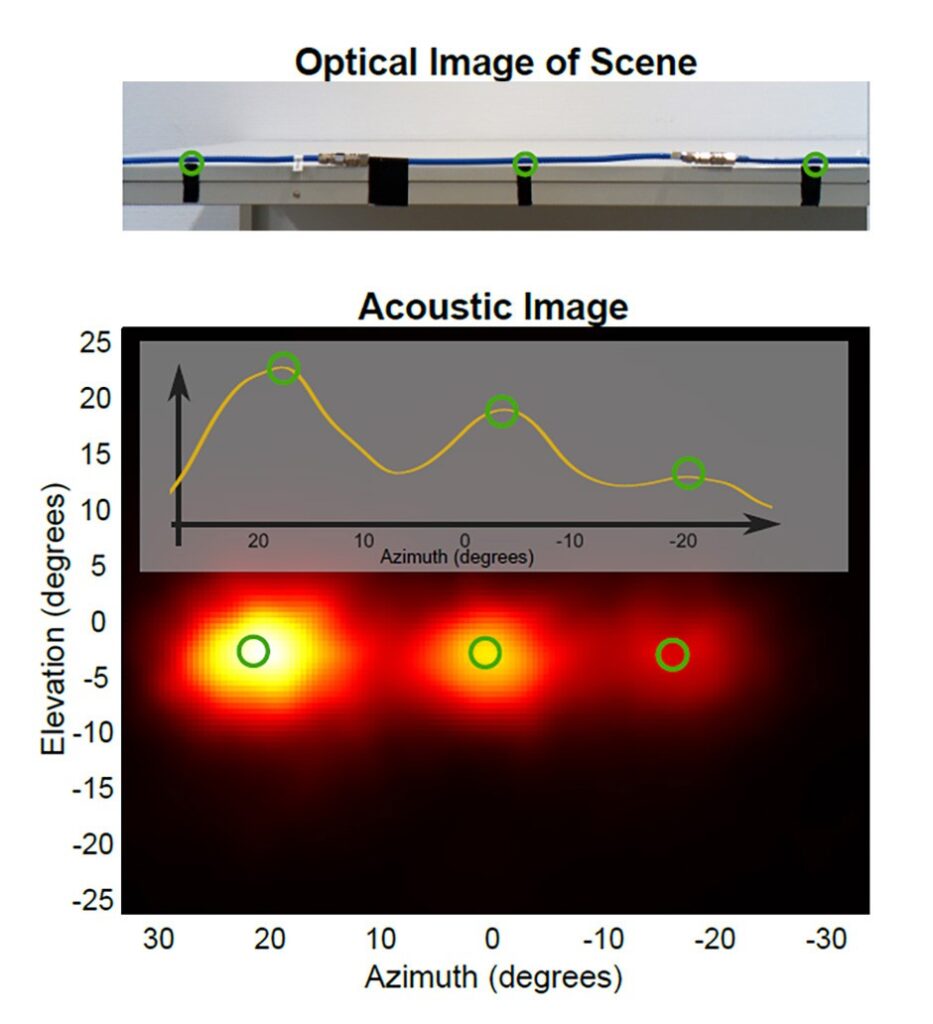
Researchers evaluated the technology using a compressed-air conduit containing three defined leak sites. PiCASo successfully distinguished all three locations, including a leak measuring 0.3 mm in diameter.
The team also conducted indoor mapping tests. Using reflected ultrasonic signals, the platform generated acoustic images at distances of up to six meters, identifying and locating walls, radiators, passageways, and other objects.
“Our priority is to pack as much sensing capability as possible into the smallest possible space,” said Dr. Sandro Koch, Head of the Acoustic Sensors and Systems business unit at Fraunhofer IPMS.
Koch added that “PiCASo demonstrates the potential of broadband ultrasound for compact robotic systems.” He said the technology enables robots and autonomous systems to map surroundings, detect objects, and navigate in unfamiliar environments while adapting to changing conditions.
The project received funding from Germany’s Federal Ministry of Research, Technology and Space through the iCampus 2 initiative. The research will be presented at the IEEE/SICE International Symposium on System Integration (SII 2027) in Kobe, Japan, in January 2027.
27 November 2026
- Share: