


ASIA ELECTRONICS INDUSTRYYOUR WINDOW TO SMART MANUFACTURING
NVIDIA: AI Factories Ignite Global Compute Boom
NVIDIA CEO Jensen Huang said the global technology industry is undergoing its most significant shift in decades, as enterprises and governments transition from traditional data centers to “AI factories” built to generate intelligence at scale.
Speaking at NVIDIA’s GTC Taipei 2026 keynote, Huang framed artificial intelligence as an economic engine rather than a research tool. He said AI is now delivering real business outcomes and driving national competitiveness, marking a turning point in how computing is deployed and valued.
AI Factories Reshape the Foundations of Computing
At the core of Huang’s message is the emergence of AI factories—large-scale systems designed to continuously produce outputs such as insights, decisions, and autonomous actions. Unlike conventional data centers that support applications and storage, AI factories operate as production systems for intelligence.
“Ultimately, our customers don’t want to buy computers, they want to build AI factories,” Huang said.
He described the global push to build these systems as the largest infrastructure expansion in history, driven by the direct link between computing and revenue. As AI workloads shift toward continuous operation, organizations are scaling infrastructure to maximize output rather than minimize cost.
The result is a new economic model where performance, efficiency, and throughput define competitiveness. Computing is no longer simply an IT function—it is a core business driver.
Vera Rubin Platform Anchors AI Infrastructure
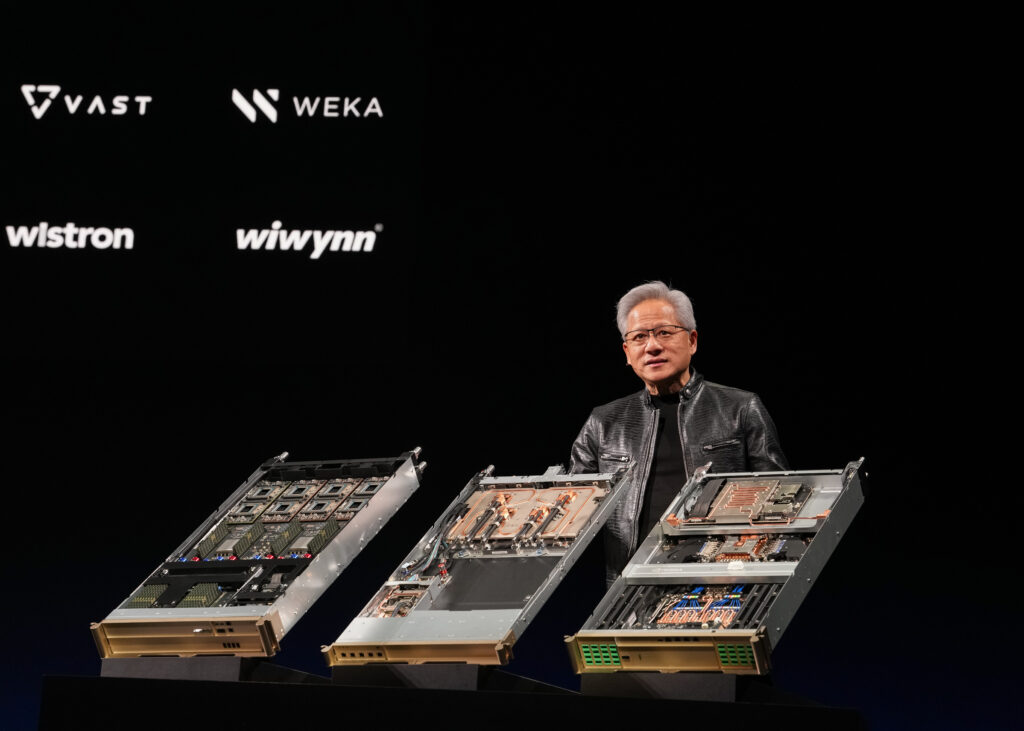
To support this transformation, NVIDIA introduced its next-generation Vera Rubin platform, a rack-scale system that integrates CPUs, GPUs, networking, and storage into a unified architecture.
Designed as the foundation of AI factories, Vera Rubin enables large-scale deployment of AI workloads across enterprise and cloud environments. The platform reflects a shift toward system-level design, where compute, memory, and networking are tightly coordinated to deliver performance and efficiency at scale.
Huang said demand for such systems is accelerating, requiring expanded global production and supply chains.
Infrastructure Evolves Beyond Chips
Huang emphasized that modern AI infrastructure extends beyond raw compute power. It requires coordinated systems that manage data movement, storage, and communication across massive clusters.
To address this, NVIDIA introduced BlueField‑4 STX, a storage architecture designed for AI workloads that rely on long-context data. The system enables faster access to large datasets, ensuring that AI applications maintain performance as complexity increases.
The company also expanded its networking capabilities with Spectrum-X, designed to support high-speed communication across thousands of interconnected processors. Together, these technologies form the backbone of AI factories, enabling distributed systems to function as a single, unified platform.
Huang said this integrated approach reflects NVIDIA’s transformation into a full-stack infrastructure company, delivering complete systems rather than standalone components.
Autonomous AI Agents Become Core Workloads
Huang said the rapid expansion of AI infrastructure is driven by a new generation of systems known as agentic AI—autonomous agents capable of reasoning, planning, and executing tasks independently.
He described agent-based computing as the dominant model for the next decade, replacing traditional application-driven workflows. Instead of users interacting with software directly, AI agents will handle tasks across systems, operating continuously and making decisions in real time.
This transition is expected to reshape enterprise operations, enabling automation at a scale not previously possible.
New Computing Architecture for AI Agents
To support agent-based workloads, NVIDIA introduced the Vera CPU, a processor designed specifically for AI systems. Unlike traditional CPUs built for human interaction, the Vera CPU is optimized for autonomous processes that require high responsiveness and efficient execution.
The company also unveiled a broader software stack, including its Agent Toolkit, which allows enterprises to build and deploy AI agents across environments. The platform integrates models, orchestration tools, and runtime systems into a unified framework.
A key component of this stack is OpenShell, a runtime environment that governs how agents operate. The system provides isolation and policy enforcement, addressing security concerns associated with autonomous systems.
NVIDIA also introduced NemoClaw, an open deployment framework for always-on AI agents, along with Nemotron models, which provide the reasoning capabilities required for complex tasks.
AI Moves to PCs and Edge Systems
Huang said the shift toward agent-based computing extends beyond data centers into personal devices.
NVIDIA introduced RTX Spark, a new chip designed to power AI-enabled PCs capable of running models locally. These systems allow users to operate AI workloads continuously without relying entirely on cloud infrastructure.
The company is working with Microsoft and industry partners to develop a new generation of AI-native PCs, signaling a broader transformation in endpoint computing. Devices are being redesigned as platforms for persistent AI agents rather than traditional applications.
Physical AI Expands Into Real-World Systems
Beyond enterprise and personal computing, Huang said AI is expanding into physical environments—what he described as “physical AI.”
This includes robotics, industrial automation, and autonomous vehicles, where systems must perceive and interact with the real world. NVIDIA introduced Cosmos 3, a model designed to simulate physical environments, enabling AI systems to learn and operate in complex settings.
The company also expanded its robotics platform with Isaac GR00T, a framework for building intelligent machines, and introduced tools for autonomous vehicle development.
Huang said these systems are already being deployed across industries, with applications spanning manufacturing, logistics, and transportation.
Toward a Unified AI Ecosystem
Huang’s keynote outlined a unified vision for computing, where infrastructure, software, and applications are tightly integrated to support AI-driven systems.
From AI factories and autonomous agents to edge devices and robotics, NVIDIA is positioning its platforms as the foundation for a new computing era centered on the generation and execution of intelligence.
The shift represents a redefinition of computing itself—from general-purpose processing to purpose-built systems designed to produce measurable value.
01 June 2026
- Share: