



ASIA ELECTRONICS INDUSTRYYOUR WINDOW TO SMART MANUFACTURING
Qualcomm Ignites Global AI Agent Hardware Revolution
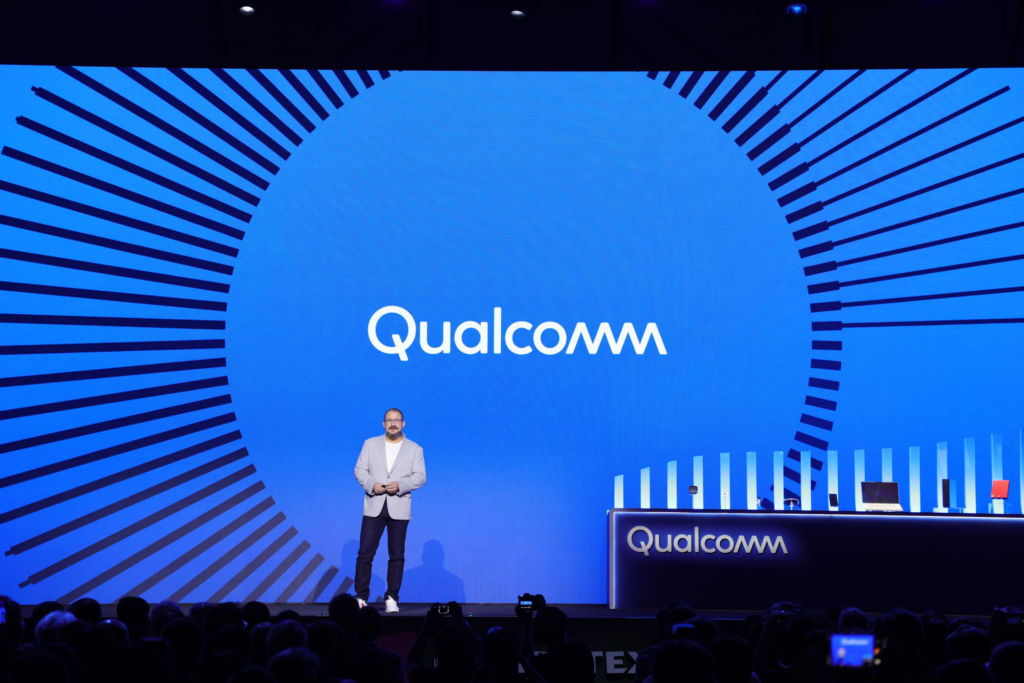
Qualcomm President and CEO Cristiano Amon declared 2026 as the “year of agents” at Computex 2026, outlining a dramatic architectural and economic shift sweeping across the global computing landscape.
During his keynote speech attended by industry partners and suppliers, including manufacturing partner TSMC, Amon detailed how artificial intelligence is rapidly evolving from a basic tool that answers prompts into a network of autonomous companions capable of taking proactive actions on their own across billions of edge devices.
“About two years ago, we talked about how AI will change the human computer interface and as a consequence will change the architecture of all of our personal computing devices. That is starting to become a reality in 2026,” Amon said.
“That’s why we call it at Qualcomm, 2026 is the year of agents and it’s now how AI is really evolving and is going to get to incredible amount of scale,” he added.
Structured Around AI Agents
According to Amon, the technology sector is moving away from a traditional smartphone-centric model toward an ecosystem entirely structured around AI agents. In this new paradigm, devices like mobile phones, personal computers, vehicles, and wearables serve as open end-points for pervasive AI rather than isolated hardware platforms.
This transition presents massive operational opportunities given the current scale of global edge hardware, which includes six billion smartphones, two billion personal AI wearable devices, two billion PCs, and half a billion connected vehicles.
However, Amon emphasized that contemporary devices were not originally designed for these experiences. While current hardware is built for actions initiated by a human user, autonomous agents must operate continuously, carry context forward, and orchestrate complex multi-step workflows without human intervention.
Meeting these demands requires tighter integration across hardware compute domains. Qualcomm argues that devices will need a robust, power-efficient CPU to handle system orchestration, combined with high-compute-density Neural Processing Units (NPUs) and Graphics Processing Units (GPUs) to run localized AI models.
Managing strict power constraints remains the chief engineering hurdle. Amon noted that keeping a smartphone battery lasting all day while an autonomous agent runs continuously alongside human use requires massive efficiency improvements. The company is addressing these diverse edge demands by engineering scalable, dedicated computing solutions ranging from sub-two-milliwatt systems for personal audio earbuds up to high-kilowatt frameworks for data centers.
Unveils Dragonfly Data Center Brand
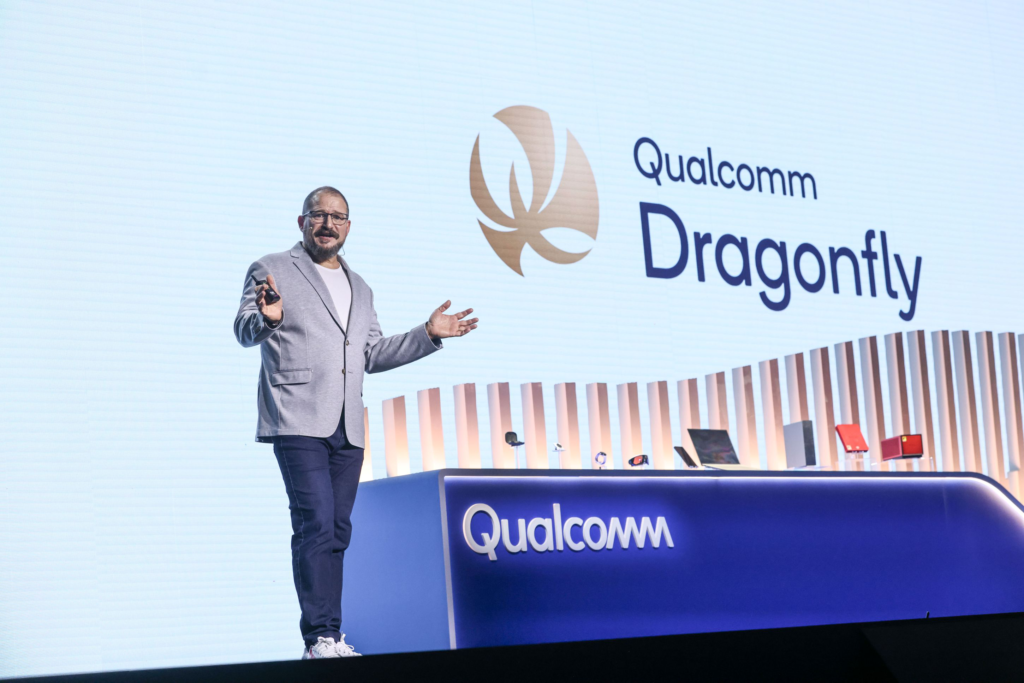
Expanding on its data center projects, Qualcomm officially announced “Dragonfly,” its new product brand dedicated to data center applications. Amon revealed that Qualcomm is already working with hyperscalers and global partners on real-world Dragonfly deployments, extending its compute portfolio across the entire edge-to-cloud continuum. Further details regarding the enterprise roadmap will be unveiled at the company’s upcoming Investor Day on June 24.
The keynote also highlighted how this agentic shift alters the underlying economics of AI, driving global token consumption to unprecedented levels. While standard level-one conversational prompts consume roughly 10,000 tokens per turn, level-three autonomous agentic workflows require approximately one million tokens per task. Amon cited estimates projecting that global token demand within a ten-second window will explode from 31.7 billion tokens in 2026 to 1.27 trillion tokens by 2030, eventually reaching the quintillions annually.
To manage these soaring costs, Qualcomm is championing a “distributed AI” architecture that intelligently routes workloads between edge hardware and cloud infrastructures. Keynote demonstrations revealed that distributing compute for intensive coding tasks can cut execution costs by 60 percent and save 1.4 million tokens. Similarly, generating a webpage using a distributed orchestrator achieved identical results at a four-times lower cost and with 30 percent fewer cloud tokens.
Integration Across Various Applications
Beyond personal computing, Amon detailed physical AI integration across cars, robotics, and industrial ecosystems. Modern vehicles are transitioning into “AI-defined vehicles,” utilizing integrated cockpit agents alongside physical AI layers that interpret camera, radar, and sensor data for autonomous navigation. In robotics, Qualcomm is creating hierarchical platforms supporting multi-layered processing for real-time actuation, reasoning, and fleet management from prototype to production.
Looking forward, Amon identified upcoming 6G wireless technology as the definitive backbone for this age of AI, combining high-speed uplink connectivity, distributed computing, and radio-frequency sensing. By utilizing radio signals as physical AI inputs, 6G networks will be capable of creating real-time digital twins of entire neighborhoods, cities, and countries to supply continuous context directly to edge agents. Amon concluded that this profound shift will trigger one of the largest hardware upgrade cycles the technology industry has ever experienced.
02 June 2026
- Share: