


ASIA ELECTRONICS INDUSTRYYOUR WINDOW TO SMART MANUFACTURING
Marvell Bets Big on Optical Connectivity in AI Era
Marvell Chairman and CEO Matt Murphy took the COMPUTEX 2026 keynote spotlight Tuesday and emphasized the future of artificial intelligence (AI) scaling is not just a battle of raw processor speeds or memory bandwidth but also of a massive connectivity challenge.
In his keynote, Murphy detailed how Marvell has positioned itself as a “connectivity-first” semiconductor company — and why optical interconnects will reshape AI infrastructure over the coming decade.
“The next major wave of innovation and scale will come from the underlying connectivity of these systems,” Murphy declared to the audience. “And as those connections move from copper to optical, they will unlock new architectural possibilities.”
Murphy outlined an architectural shift that positions high-speed data movement as the primary bottleneck—and the next major frontier—of the AI era. Driven by the physical limitations of copper at ultra-high speeds, the semiconductor industry is accelerating a massive transition toward optical interconnects and co-packaged optics (CPO) to stitch together tens of thousands, and eventually millions, of distributed processors into a unified compute engine.
Unveiling Next-Generation 100T Ethernet Switching
To cement its position in the data infrastructure space, Marvell capitalized on its COMPUTEX platform to unveil a groundbreaking piece of networking hardware designed specifically to handle gigawatt-scale cloud workloads.
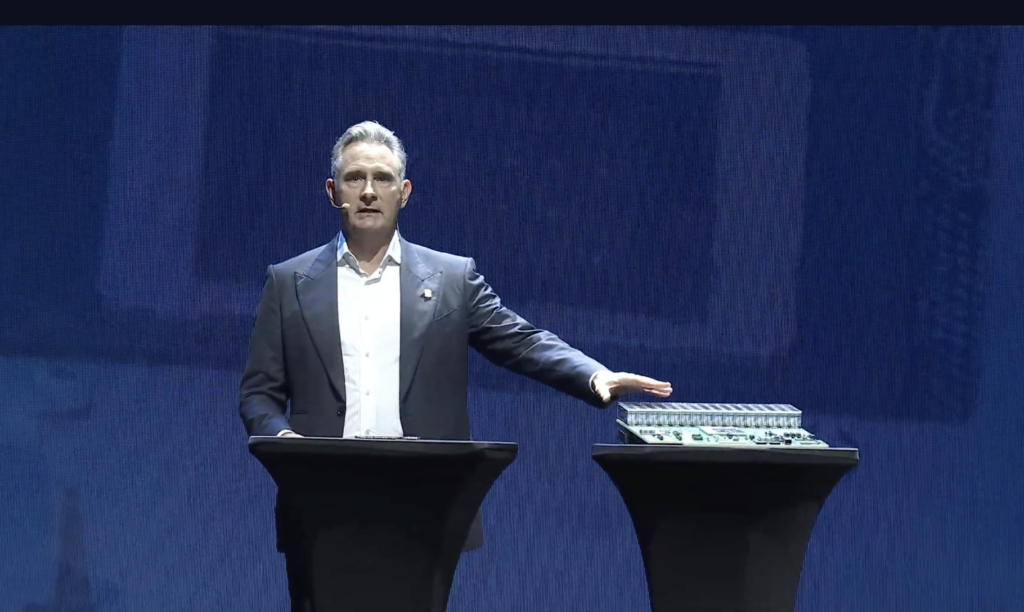
The company announced its new 100T TeraLink Ethernet switch, marking a massive breakthrough for scale-out data center fabrics. The architecture offers the industry’s lowest power consumption for an AI-optimized switch, facilitating high-density, high-bandwidth communication between expanding data center clusters.
To demonstrate the real-time execution of this technology, Murphy showcased a traditional layout alongside a highly advanced 51.2T CPO-based switch featuring sixteen 3.2T optical engines integrated directly onto the package substrate. By bringing the fiber optics directly to the silicon die, Marvell effectively bypassed the traditional circuit board constraints.
“We’ve completely eliminated the copper traces on the PCB. Light comes directly out of the package,” Murphy noted. “Co-package optics is here and the industry is scaling up to meet the challenge.”
Beyond switching, Marvell detailed its incoming 1.6 Terabit (T) connectivity pipeline. This includes ramping its 1.6T 3-nanometer Pam4 solutions for intra-data center routing and preparing to sample the world’s first 1.6T 2-nanometer coherent optical solution later this year for long-haul, data center interconnects.
NVIDIA and Marvell: Deeper Collaboration
Highlighting the interconnected nature of the modern semiconductor supply chain, NVIDIA CEO Jensen Huang joined Murphy on stage to discuss the deep integration between the two enterprise giants.
The onstage appearance comes after recent announcement on the US$2 billion strategic investment made by NVIDIA into Marvell to aggressively co-develop advanced optics, silicon photonics, and NVLink Fusion architectures.
Huang highlighted how new computing paradigms require massive infrastructure flexibility. Modern generative AI, particularly Mixture of Experts (MoE) architectures and reasoning models, utilizes a distributed, disaggregated workflow that spreads a single workload across an entire data center.
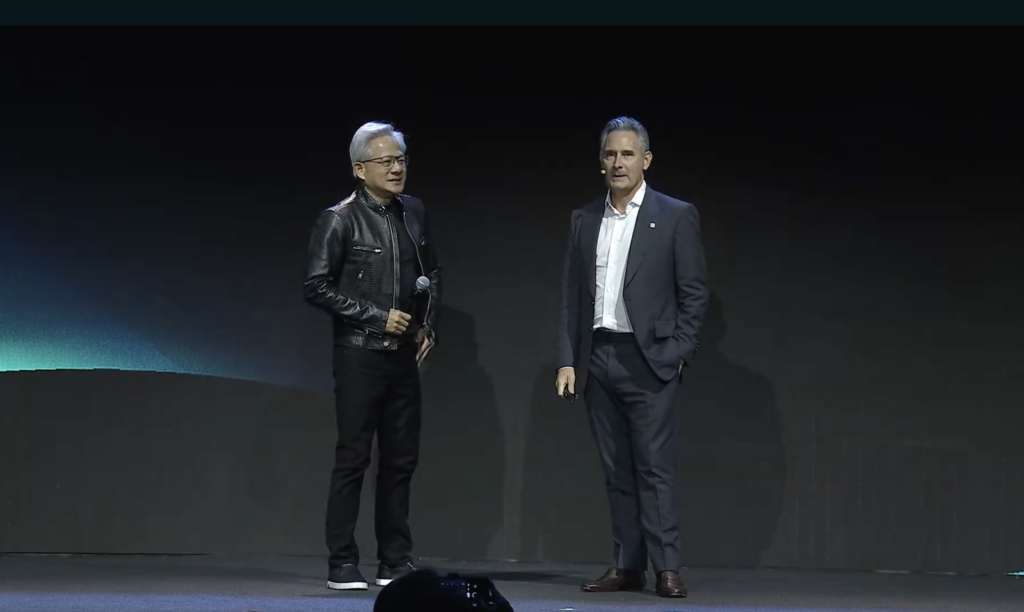
“We should use copper as much as we can for as long as we can, but
copper has its limits… After that, you scale up further with optics and you scale out with optics,” said Huang, who said Marvell is so essential and that the company is going to be “the next trillion-dollar company”.
Through NVLink Fusion, Marvell and NVIDIA are enabling cloud service providers (CSPs) to seamlessly integrate specialized semi-custom chips alongside standard platforms like Grace Blackwell and the newly detailed Vera Rubin ecosystem. This ensures identical networking topologies across heterogeneous data center deployments.
“Between the two of us, you have the benefit of a general-purpose, very high-efficiency system,” Huang said. “Anything that you want to extend to specialize, you can do so as well… It’s wonderful to see Marvell expand into all of these different clouds.”
Overcoming the Physical Barriers of the ‘Copper Wall’
A core focus of Murphy’s address centered on the unrelenting laws of physics governing data networks. At current high-speed production levels of 200 gigabits per second per lane, signal transmission over copper cables is limited to roughly 2.5 meters—just enough to wire a standard 2-meter server rack.
However, as the industry begins to design around 400 gigabits per second and higher, the maximum reach of copper drops in half. This creates an inevitable hurdle that Marvell terms the “copper wall.”
Because double the bandwidth requires cutting copper cable distance in half, even short links inside an individual server rack must transition to fiber optic cables. Because photons traveling through glass carry data independent of bandwidth frequency, shifting to optical pathways unlocks a complete reconfiguration of the physical architecture.
Global Manufacturing and the Power of the Taiwan Ecosystem
To translate these advanced optical designs into millions of real-world units, Marvell relies heavily on its long-standing manufacturing partnerships within Taiwan. Advanced Semiconductor Engineering (ASE) CEO Dr. Tien Wu joined Murphy on stage to emphasize the sheer scale of the investment and institutional knowledge required to sustain this AI boom.
Wu explained that Taiwan’s tightly grouped supply chains, combined with a collective workforce of over 1.1 million high-tech employees, have created a uniquely efficient cluster that cannot be easily replicated elsewhere in the world.
“Taiwan ASE is in the manufacturing sector. So we’re looking for partners… who can provide the insight for the next generation architecture,” Wu stated, reflecting on ASE’s early bets on Marvell’s data infrastructure pivot. “For the last 10 years, I’m just really happy everything that we talked about—it was a dream 10 years ago—and today we are going to ship it.”
Looking Ahead: The ‘Data Center Without Distance’
Ultimately, Marvell’s long-term enterprise vision predicts a complete erasure of the geographical boundaries that limit current computing layouts. By swapping out copper interconnects for unconstrained optical fabrics, future data centers can completely pool discrete resources on the fly. Instead of buying rigid, pre-configured server systems where fixed ratios of CPUs, memory, and accelerators sit underutilized, enterprise architects will dynamically compose custom hardware stacks tailored precisely to the model being run.
“This is the next era of computing infrastructure,” Murphy concluded. “A data center without distance, where compute, memory, networking, and photonics operate as one unified system.”
02 June 2026
- Share: