ASIA ELECTRONICS INDUSTRYYOUR WINDOW TO SMART MANUFACTURING
NVIDIA, IBM Build Hybrid Quantum Computing Platform
American tech companies NVIDIA and IBM along with the U.S. Department of Energy’s Fermi National Accelerator Laboratory are collaborating on a new quantum-classical codesign platform designed to address two of quantum computing’s largest challenges: scaling systems and improving error correction.
The initiative combines NVIDIA accelerated computing infrastructure with IBM quantum processors to support research into modular quantum architectures, hybrid applications and future fault-tolerant systems.
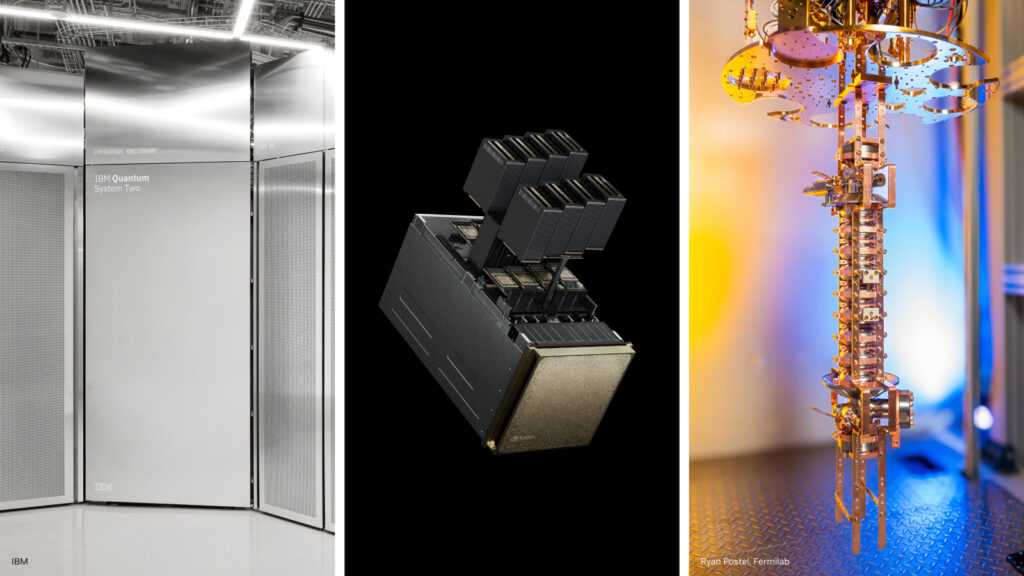
The announcement reflects a broader shift in the quantum industry away from isolated processor development and toward integrated quantum-classical environments. Under the collaboration, NVIDIA DGX B200 systems will be colocated with IBM quantum computers, including systems powered by IBM’s Quantum Nighthawk processor, creating a platform for researchers to evaluate error-correction methods, decoding algorithms and scientific applications.
Focus Moves Beyond Quantum Hardware
The platform will be used to study how classical computing resources can scale alongside multiple interconnected quantum processors within modular architectures. Fermilab will contribute expertise in quantum error correction and high-energy and nuclear physics applications, helping define requirements for future fault-tolerant quantum systems.
“Making quantum computers useful for science requires advances in error correction, applications and the systems that bring quantum processors and accelerated computing together,” said Krysta Svore, vice president of applied research for quantum computing at NVIDIA. “NVIDIA’s research software and our collaboration with IBM give scientists more powerful tools to investigate quantum designs and develop applications across these systems.”
Jerry Chow, IBM Fellow and chief technology officer of quantum-centric computing, emphasized the role of hybrid architectures in addressing scientific challenges.
“Scaling quantum and classical together will open new frontiers in high-energy and nuclear physics and beyond,” Chow said. “We plan to explore how these real-world problems can help us shape the modular, interconnected architectures that will define the next generation of quantum computers and accelerated classical computing.”
Error-Correction Research Accelerates
Separately, NVIDIA unveiled TCBP-JOBS, a new decoding algorithm available through its CUDA-Q QEC library. According to the company, the software can accelerate key quantum error-correction research workloads by up to 13,000 times while maintaining high accuracy. The result could significantly reduce the time required to evaluate new error-correction approaches and quantum computer designs.
In parallel, NVIDIA is expanding the Slurm workload manager with new capabilities that allow researchers to schedule quantum processors alongside CPUs and GPUs using common supercomputing tools. IBM is contributing integration through its Quantum Resource Management Interface, aimed at simplifying adoption within hybrid computing environments.
Together, the developments underscore increasing industry efforts to position quantum processors as components of broader accelerated computing infrastructures rather than standalone systems.
17 November 2026
- Share: