


ASIA ELECTRONICS INDUSTRYYOUR WINDOW TO SMART MANUFACTURING
Curtains Close as SEMICON India Charts Bold Chip Growth
SEMICON India 2026 concluded with a strong message: India is rapidly expanding from a semiconductor design powerhouse into a comprehensive semiconductor ecosystem spanning manufacturing, advanced packaging, indigenous computing, research, talent development and international collaboration.
A defining theme of this year’s event was the transition from the initial semiconductor mission to the next phase of development under Semicon 2.0.
Prime Minister Narendra Modi, who inaugurated the event, highlighted India’s progress from policy discussions and project planning to commercial semiconductor production. During the event, he virtually inaugurated commercial production lines at CDIL Semiconductor in Mohali and Suchi Semicon in Surat, bringing the number of operational commercial semiconductor units among approved projects to five.
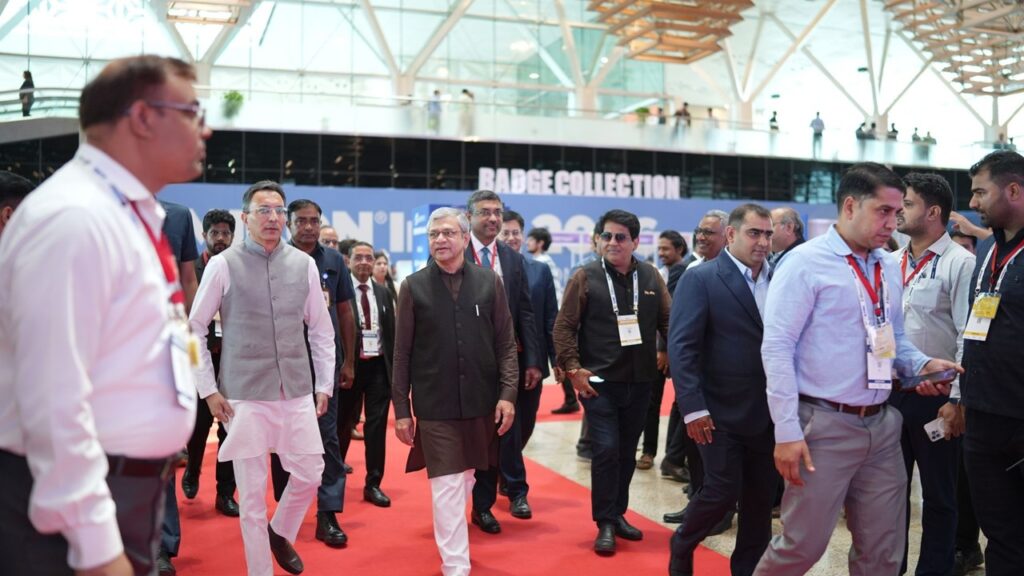
The Prime Minister also outlined the Semicon 2.0 program, which carries an outlay of ₹1.27 lakh crore and focuses on six key pillars: design, machines and materials, new fabrication facilities, advanced packaging, research, and talent development.
The strategy reflects India’s intention to build capabilities across the entire semiconductor value chain rather than focusing solely on chip fabrication.
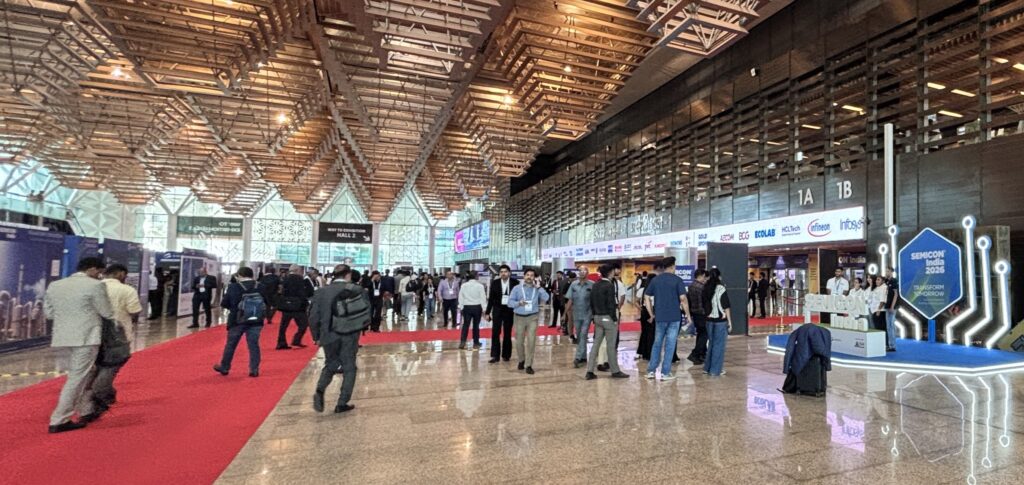
Held from September 17 to 19 at Yashobhoomi in New Delhi, the fifth edition of the country’s flagship semiconductor event drew more than 600 exhibitors, including around 300 international participants from 52 countries. The conference also featured 150-plus speakers, six country pavilions and 12 state pavilions, underscoring the growing global interest in India’s semiconductor ambitions.
The event recorded more than 51,000 registrations and a cumulative foot traffic of about 40,000, highlighting the increasing momentum behind India’s semiconductor strategy.
Global Partnerships and Ecosystem Expansion
One of the most significant outcomes of SEMICON India 2026 was the announcement of 56 memorandums of understanding, partnerships and strategic initiatives.
These agreements spanned semiconductor design, fabrication, advanced packaging, equipment, materials, artificial intelligence, high-performance computing, power electronics, logistics, research and workforce development.
The conference also hosted a series of international roundtables involving the United States, Japan, Singapore, Europe, South Korea and Malaysia. Discussions focused on technology collaboration, resilient supply chains, advanced packaging, manufacturing, investment and talent development.
The breadth of participation demonstrated growing confidence among global industry stakeholders in India’s long-term role within the international semiconductor supply chain.
Industry Eyes Long-Term Growth
A report launched by EY and the India Semiconductor and Electronics Association (IESA) during the event projected that India’s semiconductor market could expand from nearly USD 64 billion in 2026 to USD 200 billion by 2035.
The report outlines a pathway for India to leverage its domestic demand, design expertise and manufacturing investments to secure a more influential position in the global semiconductor landscape.
As SEMICON India 2026 concluded, the industry’s message was clear: India’s semiconductor ambitions are evolving beyond capacity creation toward ecosystem leadership. With growing international partnerships, expanded manufacturing activity, indigenous computing initiatives and a strong focus on talent, the country is positioning itself as an increasingly important player in the global semiconductor value chain.
Sovereign Computing Emerges as Strategic Priority
The final day of the event placed special emphasis on indigenous technology platforms and sovereign digital infrastructure. Among the notable announcements, C-DAC partnered with NLC India Limited to establish a data center powered by indigenous technologies for the energy sector. C-DAC also joined forces with Bharat Electronics Limited to develop indigenous high-performance computing, artificial intelligence and sovereign data-center solutions.
Further strengthening India’s domestic technology capabilities, C-DAC launched PARAM Vidya, a plug-and-play AI Excellence Lab-in-a-Box designed for universities, startups, research institutions and MSMEs. The organization also introduced PARAM Shavak-QS, a compact quantum simulation platform aimed at expanding access to quantum research and innovation.
These initiatives signal a growing focus on reducing dependence on external computing infrastructure while advancing homegrown digital capabilities.
Innovation and Startups Drive Momentum
Innovation remained a central theme at SEMICON India 2026. The Digital India RISC-V Grand Challenge attracted 1,236 teams comprising more than 5,000 participants. Winning projects demonstrated practical applications of indigenous SHAKTI and VEGA processor technologies, ranging from autonomous water-cleaning robots to digital healthcare solutions and environmental monitoring systems.
Startup engagement was equally strong. Under the Startup Mitra initiative, 11 startups presented their technologies to more than 20 venture capital investors, helping strengthen commercialization pathways for deep-tech innovations.
Meanwhile, the SEMICON India Hackathon drew 3,808 team registrations from 881 colleges, illustrating growing interest among students and young innovators in semiconductor technologies.
Talent Development Becomes a Core Industry Pillar
Workforce development emerged as another major priority throughout the conference.
Multiple organizations announced new partnerships focused on semiconductor training, certification and skills development. Collaborations involving the Electronics Sector Skills Council of India, Maitrio Labs, Truechip Solutions, SEMI, Peachtree Elevate, NIELIT, the Ramaiah Institute of Advanced Skills and Technology, and the Indian Institute of Science aim to create industry-ready talent across chip design, verification, testing, manufacturing and ATMP operations.
The emphasis on skilling aligns with broader industry efforts to address growing demand for specialized semiconductor professionals as India expands domestic manufacturing capabilities.
21 September 2026
- Share: