


ASIA ELECTRONICS INDUSTRYYOUR WINDOW TO SMART MANUFACTURING
Fuji Unlocks New Era for Broadcom Tomahawk 6 SMT
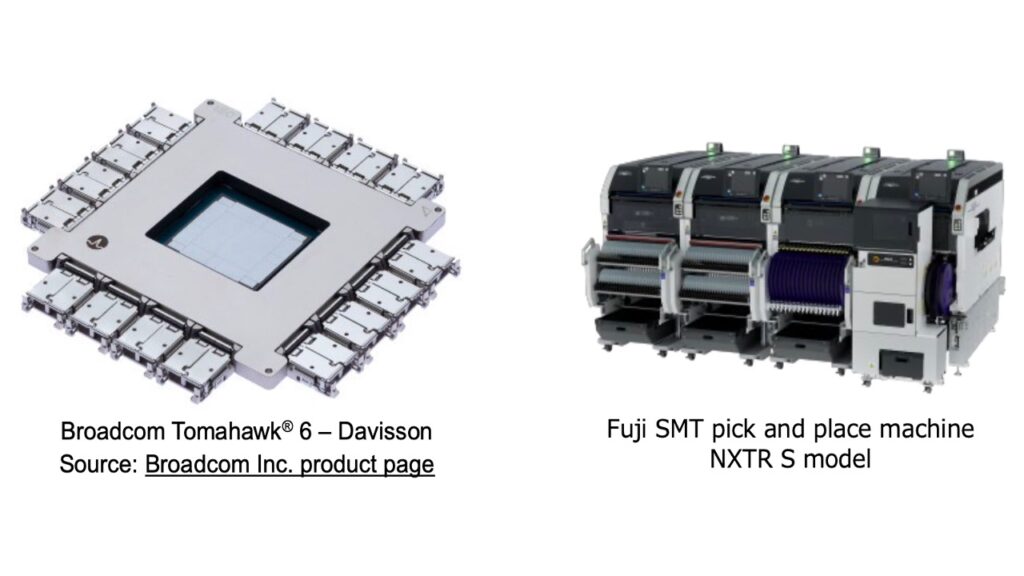
FUJI CORPORATION has successfully demonstrated what it describes as the industry’s first SMT placement of Broadcom’s Tomahawk® 6 – Davisson, a co-packaged optics (CPO) Ethernet switch designed for next-generation AI data center networks. The achievement marks a significant development for electronics manufacturers as semiconductor packages become larger, heavier, and more complex.
The evaluation was conducted jointly by Fuji, Broadcom, and Celestica using Fuji’s NXTR SMT pick-and-place platform. During the assessment, the companies verified both component transport performance and placement accuracy for the advanced networking device. According to Fuji, no other SMT pick-and-place machine supplier has publicly demonstrated successful placement of the Tomahawk 6 – Davisson component as of October 5, 2026.
AI Infrastructure Drives New Manufacturing Requirements
The milestone arrives as global demand for AI infrastructure continues to accelerate. The rapid adoption of generative AI applications is increasing the need for high-performance data center networks capable of connecting large numbers of GPUs and AI accelerators. These requirements are pushing networking equipment manufacturers toward more advanced packaging technologies that deliver higher bandwidth while reducing power consumption.
At the center of this evolution is co-packaged optics technology, which integrates a switch ASIC and optical engines within a single package. By placing optical connectivity closer to the switching silicon, CPO architectures help reduce signal loss and improve power efficiency in hyperscale and AI-driven environments.
Broadcom’s Tomahawk 6 – Davisson incorporates this approach and is positioned as a next-generation Ethernet switch for AI data center networks. The device is designed to deliver higher network performance while lowering power consumption, making it a key enabling technology for future AI clusters.
Handling Larger, Heavier Advanced Packages
A major challenge addressed during the evaluation involved the physical characteristics of the component. Fuji reported successfully placing a Tomahawk 6 – Davisson package weighing approximately 1.3 kilograms while maintaining required transport and placement accuracy.
In addition, the company said its AIMEXR SMT platform for large-panel applications is capable of supporting similar placement requirements based on its design and machine specifications. This expands manufacturing options for customers assembling increasingly sophisticated networking hardware.
Fuji Targets ‘Zero Placement Limits’
Looking ahead, Fuji plans to continue investing in technologies that remove manufacturing constraints associated with advanced electronic packages.
The company stated:”Under the concept of Zero placement limits, which aims to reduce the placements that cannot be done to zero, Fuji is working to develop technologies that eliminate restrictions in the placement process one by one.”
Fuji further noted:”Going forward, we will further strengthen our capabilities to support advanced package devices, which are becoming larger and heavier.”
The company added:”We will continue to contribute to the advancement of next-generation electronics manufacturing, including AI server-related equipment.”
The achievement underscores how equipment suppliers are adapting production technologies to meet the evolving requirements of AI infrastructure and advanced networking systems.
06 October 2026
- Share: