ASIA ELECTRONICS INDUSTRYYOUR WINDOW TO SMART MANUFACTURING
PSECE-ASEF 2026 Positions ASEAN for Next Chip Wave
Government officials and semiconductor industry leaders used the opening of the ASEAN Semiconductor and Electronics Forum (ASEF) 2026 to make a case for deeper regional cooperation, arguing that ASEAN’s future competitiveness will depend on its ability to operate as a connected semiconductor ecosystem rather than a collection of individual markets.
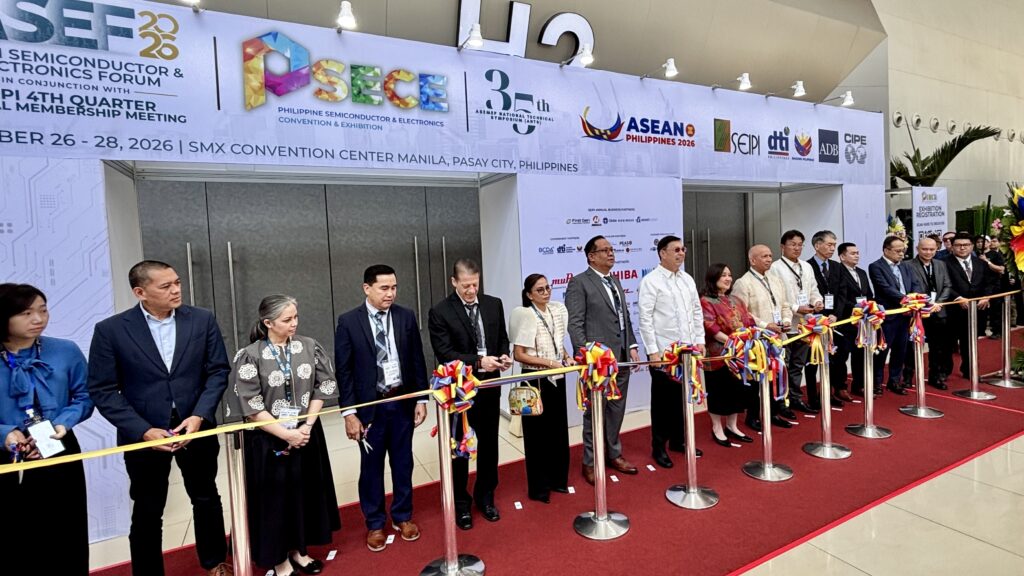
Held as part of the 21st Philippine Semiconductor and Electronics Convention and Exhibition (PSECE), ASEF 2026 gathered policymakers, technology executives, manufacturers, investors, and industry organizations under the theme, “One ASEAN, One Semiconductor Future: Building Resilient and Sustainable Global Value Chains.”
A Regional Approach to Industry Growth
In his keynote address, Ralph Recto, Executive Secretary and chairman of the Semiconductor and Electronics Industry Advisory Council, said the semiconductor sector has become critical infrastructure for modern economies.
“Chips are the new infrastructure,” Recto said. “They sit inside our phones, our hospitals, our cars, and our data centers. They will determine how far and how fast economies can grow.”
Recto argued that ASEAN’s advantage lies in combining complementary strengths across member economies.
“If we just link these strengths together, ASEAN becomes one integrated ecosystem for production and innovation,” he said. “So when an investor chooses one ASEAN country, he taps into the capabilities of the entire region.”
The comments came as industry leaders pointed to growing demand driven by artificial intelligence, advanced computing, electric vehicles, automation, and digitalization, while also acknowledging challenges stemming from geopolitical uncertainty and evolving supply-chain dynamics.
Supply Chains, Talent and Sustainability
Danilo Lachica, president of the Semiconductor and Electronics Industries in the Philippines Foundation (SEIPI), said ASEAN must focus on strengthening regional value chains, investing in talent, and improving supply-chain resilience.

“Our strength lies in connecting our capabilities, complementing one another’s expertise and building a regional ecosystem that is greater than the sum of its parts,” Lachica said.
He also called for greater collaboration in workforce development as semiconductor technologies become increasingly complex.
“We need more engineers, technicians, researchers, designers and skilled manufacturing professionals who can work with increasingly sophisticated technologies,” Lachica said.
On sustainability, Lachica emphasized that environmental performance is becoming a competitive requirement rather than solely a compliance issue.
“Our customers, investors and global partners increasingly expect responsible manufacturing, lower emissions, greater energy efficiency and stronger environmental, social and governance practices,” he said.
Forum Focuses on Long-Term Competitiveness
The ASEF 2026 program reflects those priorities. Discussions throughout the day will examine workforce development, industry-academia collaboration, investment opportunities linked to the Luzon Economic Corridor, semiconductor infrastructure, renewable energy adoption, supply-chain decarbonization, ESG initiatives, and circular manufacturing practices.
The forum will conclude with the signing of a joint communiqué among industry associations and partners from several ASEAN member states aimed at advancing regional cooperation in the semiconductor and electronics sector.
For executives attending ASEF 2026, the message was clear: ASEAN’s semiconductor future will be shaped not only by national investments, but by the region’s ability to align talent, infrastructure, innovation, and supply chains into a more integrated and resilient ecosystem.
26 October 2026
- Share: