ASIA ELECTRONICS INDUSTRYYOUR WINDOW TO SMART MANUFACTURING
IMI Advances ODM Strategy Through Automotive Vision
As the automotive industry reaches a pivotal crossroads and artificial intelligence emerges as the processing core of modern software-defined vehicles (SDVs), the automotive camera has undergone a fundamental transformation.
Automotive cameras no longer serve merely as inputs to passive display systems meant for human vision, they now function as mission-critical perception sensors that feed neural networks to dictate split-second safety decisions. Thus, posing challenges to global OEMs and Tier 1 suppliers to enable machines that can see, interpret, and respond with zero latency and absolute reliability under extreme environmental conditions.
Integrated Micro-Electronics, Inc. (IMI) has been in this space for quite some time. In fact, IMI recently reported solid earnings growth, anchored by a 12.0% year-over-year increase in core EBITDA to US$56.5 million for the first nine months, driven heavily by surging momentum in automotive camera programs and data center power modules.
Critican Updates: Philippines’ IMI Gains Ground in Data Center, Automotive Markets
As a top global electronics manufacturing services (EMS) provider and a key subsidiary of Ayala Corporation, IMI is executing a strategic pivot from traditional build-to-print manufacturing toward an Original Design Manufacturer (ODM) platform-based approach.

In this exclusive interview, Chris Tiongson, Global Head of IMI’s Camera Business, unpacks how IMI is moving beyond commodity assembly to capitalize on this commercial momentum.
WHY THIS INTERVIEW MATTERS
- »The automotive-camera market is no longer just a hardware opportunity. It is becoming a critical layer in AI-powered vehicle architecture.
- »IMI’s strategy reflects a broader industry shift from contract manufacturing toward platform-based value creation.
- »Design ownership, ecosystem integration, and simulation-driven development are becoming increasingly important competitive differentiators.
- »The next generation of automotive-electronics leaders may be those that bridge the gap between manufacturing execution and technology ownership.
From EMS to ODM
AEI: How is IMI shifting its business model to capture higher-value opportunities in the market?
Tiongson: EMS remains our core foundation, but we are now establishing specialized business units—including the new Camera Business—that will execute a true Original Design Manufacturer (ODM) model.
Instead of the traditional build-to-print approach where customers bring finished designs, the Camera BU will generate baseline platform designs. We can offer pre-engineered platform options (effectively a menu of Set A / B / C configurations matched to specific application needs). Because the engineering, tooling, and manufacturability work will already be done on the IMI side, customers avoid heavy upfront NRE, tooling costs, and long design-for-manufacturing cycles. This is the shift that lets us move beyond commodity assembly.
“Instead of a build-to-print model where customers bring their own designs, our ODM approach generates baseline designs from scratch.”- Chris Tiongson, Global Head, Camera Business
Positioning for AI-Driven Automotive Vision
AEI: With AI transforming vehicle architecture, how are optical and performance requirements changing for automotive cameras?
Tiongson: First,we have to distinguish viewing cameras (which feed instrument cluster and infotainment displays) from sensing cameras (which feed AI/ECU systems). AI is relevant to cameras that employ sensing—typically the cameras that are mounted inside the cabin like the camera for Front-sensing ADAS, the camera for Driver Monitoring System (DMS), and the camera for Occupancy Monitoring System (OMS). The cameras mounted on the exterior also share some sensing capabilities like the Surround View Monitoring cameras and cameras for e-Mirror applications as well.
Keep Exploring: From Factory to Lab: IMI ATC’s Vertical Quality Loop
The output for sensing cameras goes into an ECU that integrates AI on the edge capabilities for functions such as Automatic Emergency Braking (AEB), Collision Avoidance (CA), etc. That means sensing cameras require substantially higher optical quality and thermal stability across the full automotive range of -40°C to 85°C. These are safety-critical components, so the optical performance across the operating temperature range needs to be stable. Considerations in the optical, mechanical and electrical design aspects of the camera are key to having this stable performance.
AEI: How does IMI ensure zero-failure and low-latency performance?
Tiongson: We anchor our design methodologies to international automotive standards, specifically ISO 26262 and Automotive Safety Integrity Level guidelines. These standards dictate how our camera modules interact with the vehicle’s central ECU, ensuring that our hardware framework meets the rigorous safety compliance expected by Tier-1 system integrators and global OEMs.
Expanding the Ecosystem
AEI: Where does IMI fit within the broader automotive supply chain?
Tiongson: IMI’s Camera Business will operate primarily as a Tier-2 supplier to Tier-1 system integrators. We stay closely aligned with the roadmaps of image-sensor and lens suppliers so the modules integrate cleanly.
We deliberately do not compete with our Tier-1 customers by building complete systems. Our main focus is to provide the basic camera module that can easily integrate with the rest of the electronics in the system. A practical part of the strategy is getting IMI camera hardware onto the approved vendor lists of both the major Tier-1s and the key SoC platforms (NVIDIA, Qualcomm, Mobileye, Texas Instruments, Renesas, NXP, Ambarella, Horizon Robotics, etc.). These companies define ecosystem players around their platforms and qualify suppliers through Approved Vendor Lists (AVL). If you are not part of the AVL, you may not even be considered for a program. That is why, as a Tier-2 supplier, one of our approaches is to qualify within those SoC-vendor ecosystems in addition to working directly with established Tier-1 customers.
Scaling Advanced Packaging and Optical Innovation
AEI: IMI is widely recognized for its Chip-on-Board expertise. What technical edge does COB provide?
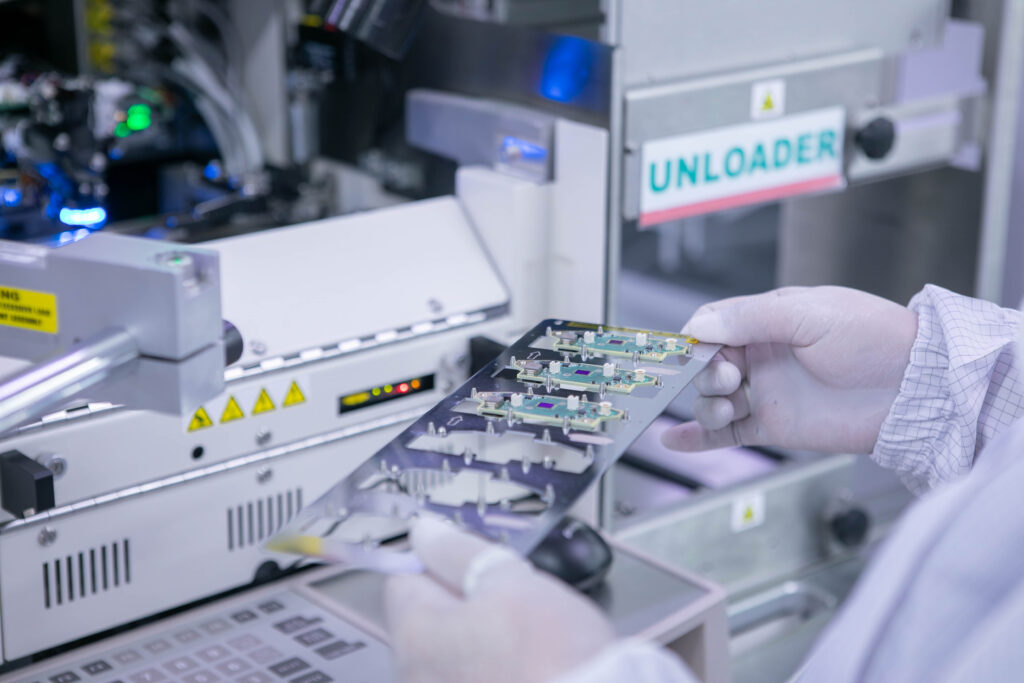
Tiongson: A key technical differentiator we are bringing into the Camera BU is automotive-grade aluminum wire bonding for bare-die COB. It gives a meaningful cost advantage versus gold-wire or even conventional packaged sensors. With gold wire prices being more than twice the price of aluminum wire, this immediately becomes a cost-saving path.
Mechanically, COB eliminates the extra protective cover glass found in conventional packages, reducing optical aberrations and stray light. By mounting the bare die directly onto the substrate, thermal management also improves because heat is transferred more efficiently to the housing. The result is both lower cost and improved optical performance.
Our primary focus remains automotive because it is among the most demanding quality environments in the industry. If we can satisfy automotive requirements, many of the same competencies can be applied to adjacent markets such as industrial robotics, warehouse automation, humanoid robotics and heavy-equipment vision systems.
AEI: Exterior cameras face significant environmental challenges. How does IMI’s Lens Heater design address them?
Tiongson: Conventional heaters typically warm the whole camera body or lens barrel—wasting energy and creating thermal stress on internal components. Our approach places the heating element directly behind the first glass lens element.
By heating only the surface that actually faces ice and frost, we get faster defrost with lower power and without stressing the rest of the module. This technology has already been deployed in commercial-vehicle applications in Europe and is part of the capability set moving with the team into the IMI Camera BU.
The Next Phase: Optical Engine and Digital Twin Manufacturing
AEI: Beyond optical vision, IMI also produces LiDAR receiver modules. How do you view the relationship between cameras and LiDAR?
Tiongson: LiDAR receivers need precise optical alignment, so there are clear process synergies with camera manufacturing. From a commercialization and cost standpoint, however, vision-based camera systems remain far more economically viable for large-scale vehicle deployment. LiDAR will continue in selected applications, but the core platform strategy of the Camera Business stays centered on cameras.
AEI: Looking ahead over the next two to five years, what technical milestones is IMI pursuing?
Tiongson: We are building the IMI Optical Engine—a vertically integrated platform that combines advanced lens integration, wide-temperature athermalization, and aluminum wire-bonding. The goal is to move beyond simply buying complete lens assemblies and develop the ability to work at the individual lens-element level inside the platform.
In parallel we are bringing up a Digital Twin simulation framework (using Ansys tools). The target is ≥90 percent correlation between the virtual model and the physical product. Once that correlation is achieved, design changes can be made in the virtual environment with high confidence.
The traditional automotive product qualification cycle is roughly two years. If the Digital Twin approach works as planned, we expect to cut that cycle substantially—potentially by half—while also reducing prototyping cost, engineering effort, and material waste.
“If we successfully realize this Digital Twin model, we believe we can significantly reduce the traditional automotive qualification cycle, potentially cutting development time in half while reducing prototyping costs and material waste.”
AEI: What core ethos guides IMI’s journey in the automotive camera space?
Tiongson: While IMI’s broader corporate identity centers on being “Engineered for Execution. Designed with Purpose”, our dedicated tagline for the camera business encapsulates our mission: “Focus that holds, vision that leads.” We are proud to bring this advanced optical engineering out of the Philippines and onto global roads, shaping the future of autonomous mobility.
Cristian Canoza
24 November 2026
- Share: